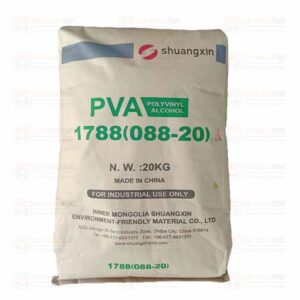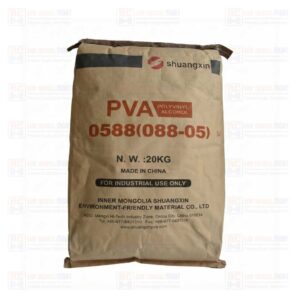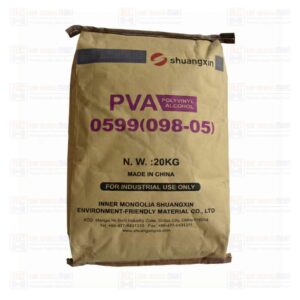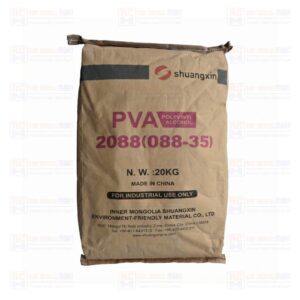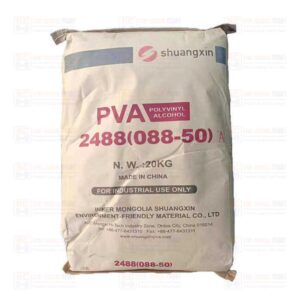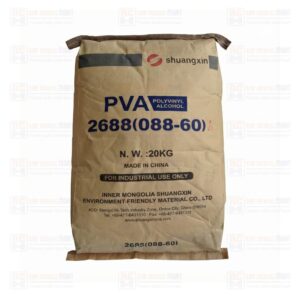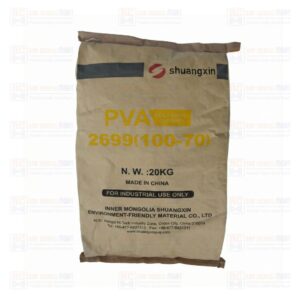


Brief Introduction:
Polyvinyl Alcohol 17-99 (also known as PVA 100-27) is a fully hydrolyzed polyvinyl alcohol polymer appearing as a white solid. Unlike partially hydrolyzed grades, PVA 17-99 is characterized by a high degree of alcoholysis (98.00 – 100.00 mol%), which imparts superior water resistance, thermal stability, and solvent resistance to the final product.
With a medium viscosity of 21.0 – 33.0 mPa.s, this grade is engineered for applications requiring strong film formation and high tensile strength, such as textile sizing and heavy-duty adhesives.
Specifications:
| Item | Specification |
|---|---|
| Degree of Alcoholysis (mol%) | 98.00 - 100.00 |
| Viscosity (mPa·s) | 21.0 - 33.0 |
| Volatile Content (wt%, max) | 5 |
| Purity (wt%, min) | 93.5 |
| pH Value | 5 ~ 7 |
| Ash Content (wt%, max) | 0.5 |
Main Characteristics:
- Solubility: PVA 17-99 has strong hydrophilicity but requires heat for dissolution. It is generally dissolved in hot water above 90°C. It is insoluble in almost all organic solvents.
- Film-Forming Property: It forms films easily with excellent mechanical properties. These films provide an exceptional barrier against gases such as Hydrogen , Nitrogen , and Oxygen .
- Thermal Stability: The product is stable up to 130°C. Fully hydrolyzed PVA begins to melt around 230°C and decomposes above 200°C.
- Reactivity: It features excellent cross-linking reactivity. It can be cross-linked with borax or undergo acetalization with formaldehyde (to form PVB) to improve water resistance.
- Chemical Resistance: Shows strong resistance to weak acids, weak alkalis, and oils
Applications:
- Textile Sizing: Used as a slurry for fibers. Unlike starch sizing, PVA 17-99 is not prone to spoilage or mildew. It offers smooth film formation, elasticity, and abrasion resistance.
- Paper Industry: Applied for paper surface sizing to improve paper strength and ink absorption. Also used in the production of paper adhesives.
- Adhesives & Glues: Due to its cross-linking capabilities, it is used to formulate water-resistant adhesives and construction glues.
- Fiber Production: A raw material for producing polyvinyl alcohol fibers and water-soluble fibers.
- Emulsions: Acts as a thickener and anti-sagging agent for various emulsions.
Packing:
- Packaging: 25 kg per bag.
- Storage: Store in a cool, dry, and well-ventilated area to prevent caking and moisture absorption.
Product Storage:
Keep in a dry, well-ventilated place to prevent moisture absorption.
FAQ:
Q: How do I dissolve PVA 17-99 compared to PVA 17-88?
A: Since PVA 17-99 is fully hydrolyzed (98-100%), it has stronger intermolecular hydrogen bonding than PVA 17-88. Therefore, it requires higher temperatures to dissolve. You must heat the water to 90°C – 95°C and stir continuously for complete dissolution. PVA 17-88 typically dissolves at lower temperatures.
Q: What is the difference between PVA 17-99 and PVA 100-27?
A: They are the same product. “17-99” is the standard nomenclature indicating viscosity (~17-27 range in some standards, here 21-33) and hydrolysis (99%). “100-27” is another common trade designation for this specification.
Q: Can PVA 17-99 be used for water-resistant coatings?
A: Yes. Because it is fully hydrolyzed, once the film is dried and formed, it exhibits much better water resistance than partially hydrolyzed grades. Its water resistance can be further improved by cross-linking with borax or formaldehyde.
Get a Quote for PVA 17-99 / 100-27. We provide consistent quality and factory-direct pricing for global export.