PAC-LV vs. PAC-HV: Engineering the Optimal Drilling Fluid System
 Joe•
Joe•
Technical Overview: The Role of Polyanionic Cellulose (PAC) in Industrial Rheology Polyanionic Cellulose (PAC) is a premium, high-purity water-soluble cellulose ether derived from natural cellulose through chemical modification (etherification). In the hierarchy of oilfield chemicals and dry-mix mortars, PAC stands as a superior alternative to CMC (Carboxymethyl Cellulose) due to its higher degree of substitution
Technical Overview: The Role of Polyanionic Cellulose (PAC) in Industrial Rheology
Polyanionic Cellulose (PAC) is a premium, high-purity water-soluble cellulose ether derived from natural cellulose through chemical modification (etherification). In the hierarchy of oilfield chemicals and dry-mix mortars, PAC stands as a superior alternative to CMC (Carboxymethyl Cellulose) due to its higher degree of substitution (DS) and enhanced salt tolerance.
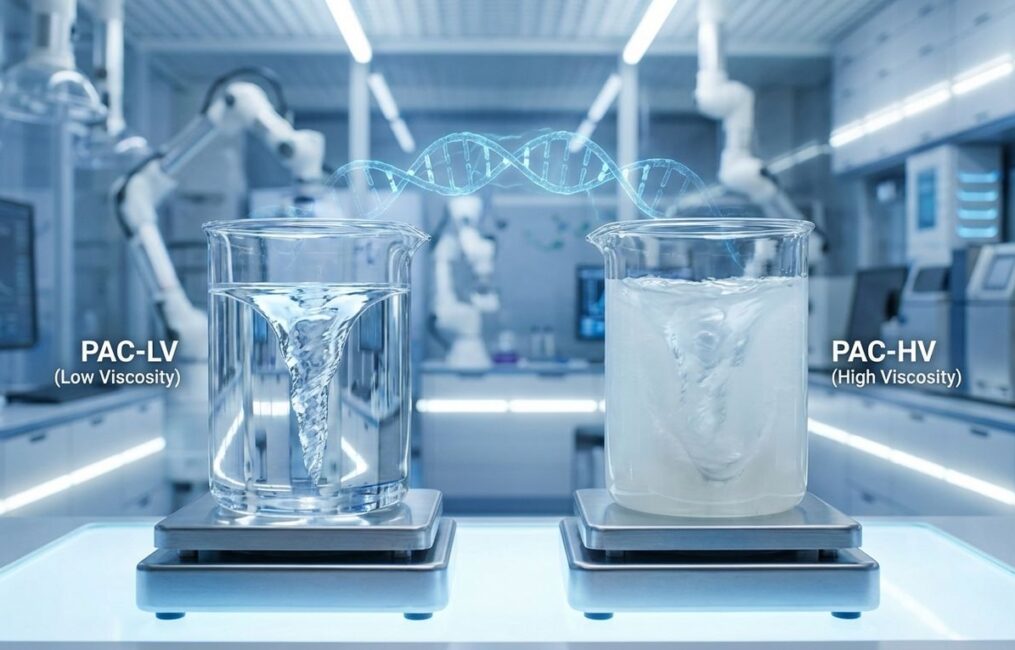
For procurement officers and mud engineers, the distinction between PAC-LV (Low Viscosity) and PAC-HV (High Viscosity) is not merely a matter of thickness; it is a strategic choice dictated by the geological formation, the required filtration rate (FL), and the desired rheological profile of the drilling fluid.
Chemical Properties & Technical Specifications
The performance of PAC is governed by its macromolecular structure. Both variants are anionic polymers, but their chain lengths and molecular weight distributions differ significantly to serve divergent mechanical functions.
Technical Specification Comparison (API-13A Standards)
| Property | PAC-HV (High Viscosity) | PAC-LV (Low Viscosity) |
| Appearance | Off-white free-flowing powder | Off-white free-flowing powder |
| Moisture Content | ≤ 10% | ≤ 10% |
| Degree of Substitution (DS) | ≥ 0.9 | ≥ 0.9 |
| Purity | ≥ 95% | ≥ 95% |
| Apparent Viscosity | ≥ 50 mPa·s | ≤ 40 mPa·s |
| Fluid Loss (API) | ≤ 16.0 ml | ≤ 16.0 ml |
| Primary Function | Viscosifying + Fluid Loss Control | Fluid Loss Control (Minimal Viscosity) |
Industrial Applications: PAC-HV vs. PAC-LV
1. PAC-HV: The Viscosifier and Stabilizer
PAC-HV is engineered for applications where both fluid loss control and increased carrying capacity are required.
- Mechanism: Its long polymer chains create a high-density network that traps water molecules, increasing the Yield Point (YP) and Plastic Viscosity (PV) of the mud.
- Best For: Low-solids drilling fluids, freshwater systems, and top-hole drilling where lifting cuttings to the surface is the primary challenge.
2. PAC-LV: The Filtration Specialist
PAC-LV is optimized for high-density fluids where adding further viscosity would lead to excessive equivalent circulating density (ECD) and potential formation fracture.
- Mechanism: By utilizing shorter polymer chains, PAC-LV coats the wellbore wall with a thin, tough, and impermeable filter cake without significantly altering the fluid’s flow resistance.
- Best For: High-density brine systems, salt-saturated muds, and horizontal drilling where maintaining a low rheological profile is critical for hydraulic efficiency.
💡 Need a Complete Overview of PAC?
Before diving into grades, understand the full industrial impact and applications of Polyanionic Cellulose.
Read the Full Industrial Guide →Performance Optimization: The Selection Flowchart
Choosing the correct grade is vital for maintaining wellbore stability and reducing Non-Productive Time (NPT). Use the following logic for procurement and application:
- Scenario A: Drilling through permeable sand with low mud weight.
- Selection: PAC-HV. You need the viscosity to suspend cuttings and the filtration control to prevent water invasion.
- Scenario B: Drilling deep sections with high solids or high-density brines.
- Selection: PAC-LV. You must control fluid loss to prevent pipe sticking, but adding viscosity would make the mud unpumpable.
- Scenario C: High-Salinity / Saturated Salt Formations.
- Selection: High-DS PAC (Either Grade). Ensure the Degree of Substitution (DS) is > 0.9 to prevent polymer precipitation in the presence of Cl- and Ca2+ ions.
The Chemistry of Performance: Why PAC Outperforms CMC
The efficacy of PAC in harsh environments is due to the distribution of carboxymethyl groups along the cellulose backbone. In PAC-LV and HV, the higher DS ensures that fewer “bare” hydroxyl (-OH) groups are available for interaction with divalent cations (Ca2+, Mg2+).
Reaction Formula :
Cellulose-OH + ClCH2COONa (with NaOH) -> Cellulose-O-CH2COONa + NaCl + H2O
This chemical stability prevents “flocculation,” a common failure in dry-mix mortars and drilling muds where the polymer collapses, leading to massive fluid loss and sediment buildup.
Frequently Asked Questions (FAQ)
Q: Can I use PAC-HV in saltwater?
A: Yes. Unlike standard CMC, PAC-HV is designed to remain stable in salt concentrations up to saturation. However, for volume-for-volume efficiency, ensure the product is API-13A compliant.
Q: Does PAC-LV affect the pH of the system?
A: PAC is generally pH-stable between 7.0 and 11.0. If the system becomes too acidic (pH < 5), the polymer may undergo acid hydrolysis, reducing its effectiveness.
Q: How does PAC-LV improve the lifespan of drilling equipment?
A: By creating a superior filter cake, PAC-LV reduces the coefficient of friction between the drill string and the wellbore, lowering torque and drag, which extends the life of the bit and motor.
Procurement and Bulk Supply
At RawChemicalMart.com, we supply high-purity, API-grade PAC-LV and PAC-HV tailored for global oilfield services and industrial manufacturing.