Fournisseur et fabricant d'alcool polyvinylique (PVA) industriel
 Joe•
Joe•
Qu’est-ce que l’alcool polyvinylique (PVA) ? L’alcool polyvinylique (PVA) est un polymère synthétique hydrosoluble devenu indispensable dans la fabrication industrielle moderne. Contrairement à de nombreux polymères obtenus par polymérisation directe de monomères, le PVA est fabriqué par hydrolyse (saponification) de l’acétate de polyvinyle (PVAc). Cette origine chimique unique confère au PVA sa structure de base particulière, caractérisée par une alternance de groupes hydroxyle.
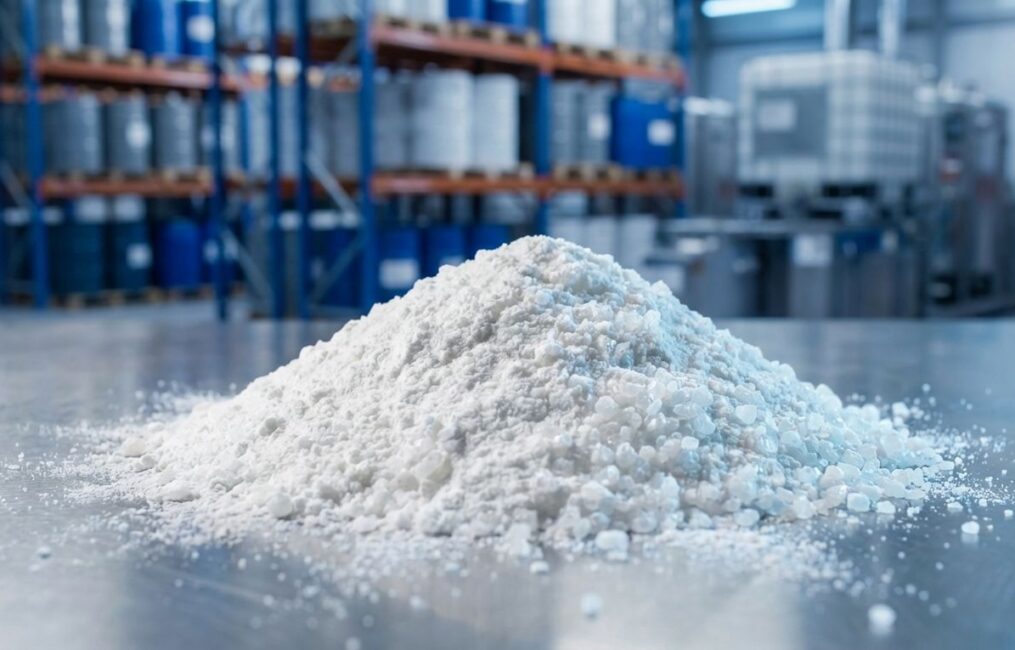
Qu'est-ce que l'alcool polyvinylique (PVA) ?
Alcool polyvinylique (PVA) Le PVA est un polymère synthétique hydrosoluble devenu indispensable dans la production industrielle moderne. Contrairement à de nombreux polymères obtenus par polymérisation directe de monomères, le PVA est fabriqué par hydrolyse (saponification) de l'acétate de polyvinyle (PVAc). Cette origine chimique unique confère au PVA sa structure de base particulière, caractérisée par une alternance de groupes hydroxyle qui favorisent de fortes liaisons hydrogène.
Pour les responsables des achats et les ingénieurs chimistes, le PVA est un ingrédient fonctionnel polyvalent, reconnu pour ses propriétés filmogènes exceptionnelles, sa haute résistance à la traction et sa résistance aux huiles, aux graisses et aux solvants. Biodégradable et non toxique, il est un choix privilégié pour les applications sensibles à l'environnement, de l'emballage alimentaire au traitement de l'eau.
À rawchemicalmart.com, Nous fournissons des qualités de PVA de haute pureté qui constituent les éléments de base des adhésifs, des matériaux de construction et des auxiliaires de traitement textile, assurant ainsi la stabilité de la chaîne d'approvisionnement mondiale pour les fabricants à grand volume.
Comprendre les qualités et les spécifications du PVA
Le choix du grade approprié d'alcool polyvinylique (PVA) ne se fait pas de manière universelle. Les performances du PVA dans toute formulation dépendent de deux paramètres techniques essentiels : Degré d'hydrolyse (Saponification) et Poids moléculaire (Viscosité).
- Degré d'hydrolyse : Cela indique le pourcentage de groupes acétate convertis en groupes hydroxyle. Ce pourcentage détermine la sensibilité à l'eau. Les grades totalement hydrolysés (98%+) offrent une résistance à l'eau et une résistance à la traction élevées, tandis que les grades partiellement hydrolysés (87-89%) offrent une excellente solubilité dans l'eau et une activité de surface élevée.
- Viscosité (masse moléculaire) : Cela est lié au degré de polymérisation. Les viscosités élevées offrent une meilleure adhérence et un pouvoir épaississant supérieur, mais peuvent être plus difficiles à dissoudre, tandis que les viscosités faibles offrent de meilleures propriétés d'écoulement et une teneur en matières solides plus élevée dans les formulations.
Pour une analyse approfondie du choix de la bonne note, consultez notre article. Guide des qualités et spécifications du PVA : poids moléculaire et hydrolyse.
Spécifications comparatives des qualités courantes de PVA
Pour aider les équipes de R&D dans la sélection des qualités, le tableau ci-dessous présente les spécifications standard disponibles via Raw Chemical Mart :
| Type de grade | Hydrolyse (mol %) | Viscosité (mPa.s) | Caractéristiques clés | Application typique |
|---|---|---|---|---|
| Partiellement hydrolysé (par exemple, 17-88) | 87,0 – 89,0% | 20 – 50 (Faible à moyen) | Soluble dans l'eau froide, forte activité de surface. | Adhésifs, polymérisation en émulsion |
| Entièrement hydrolysé (par exemple, 17-99) | 98,0 – 99,0% | 25 – 35 (Moyen) | Soluble dans l'eau chaude, haute résistance à la traction, résistant à l'eau. | Encollage textile, couchage du papier |
| Super hydrolysé | > 99,5% | Variable | Résistance maximale à l'eau et solidité du film. | Céramiques, films spéciaux |
Conseil en matière d'approvisionnement : Lors de l'approvisionnement en PVA, la constance de la teneur en cendres et en matières volatiles est tout aussi importante que l'hydrolyse. Une teneur élevée en cendres peut entraîner des problèmes de transparence dans les films transparents ou les adhésifs. Raw Chemical Mart garantit le strict respect des certificats d'analyse afin de minimiser les variations d'un lot à l'autre.
Au-delà des qualités standard, certaines applications spécialisées peuvent nécessiter une modification chimique. Découvrez comment modifier les propriétés du PVA dans notre section dédiée. Guide technique sur l'alcool polyvinylique réticulé (PVA) et sa modification.
Principales applications industrielles du PVA
Adhésifs et colles
Le PVA est un élément essentiel de l'industrie des adhésifs, notamment connu comme ingrédient principal des colles à bois blanches et des adhésifs pour papier. Sa capacité à former une liaison forte et transparente avec les matériaux cellulosiques en fait la référence dans la fabrication de meubles et la reliure. Dans ces applications, le PVA partiellement hydrolysé est souvent privilégié pour son pouvoir adhésif et sa capacité à être réhumidifié.
Explorez nos protocoles de fabrication Guide de fabrication et de formulation des adhésifs à base d'alcool polyvinylique (PVA).
Matériaux de construction et de bâtiment
Dans le secteur de la construction, le PVA est un additif essentiel pour les mélanges cimentaires, les mortiers et les enduits secs. Il renforce l'adhérence entre le béton ancien et le béton neuf, améliore la maniabilité et réduit la perte d'eau pendant le durcissement. Bien que les poudres polymères redispersibles (PPR) soient fréquemment utilisées, les solutions liquides de PVA restent un agent de liaison économique pour la préparation des surfaces.
Découvrez comment le PVA améliore les matériaux de construction dans notre Le PVA dans la construction : le guide ultime des revêtements cimentaires et des agents de liaison.
Fabrication de papier
L'industrie papetière utilise le PVA pour l'encollage de surface et le couchage pigmentaire. Le PVA forme un film résistant et transparent sur le papier, améliorant ainsi l'imprimabilité, la résistance à l'huile et aux solvants. Il constitue également un support essentiel pour les azurants optiques, garantissant ainsi un papier de haute qualité atteignant les niveaux de blancheur et de luminosité souhaités.
Découvrez plus de détails dans notre L'alcool polyvinylique (PVA) dans la fabrication du papier : revêtements et liants.
Encollage de chaîne textile
Le PVA est largement utilisé dans l'industrie textile pour l'encollage des fils de chaîne. Ce polymère forme un revêtement protecteur autour du fil, empêchant sa rupture lors du tissage à grande vitesse. Son avantage par rapport à l'amidon réside dans la résistance supérieure du film et la facilité avec laquelle il peut être désencollé (éliminé par lavage) à l'eau chaude avant la teinture du tissu.
Pour en savoir plus, consultez notre PVA dans les textiles : Guide ultime de l’encollage de chaîne et du Vinylon.
Polymérisation en émulsion
Dans la production d'émulsions polymères, telles que les latex d'acétate de vinyle-éthylène (VAE) ou de PVAc, le PVA joue le rôle de colloïde protecteur. Il stabilise les gouttelettes d'émulsion, empêchant leur coagulation et assurant leur stabilité mécanique lors du stockage et de l'utilisation. Le choix de la qualité du PVA influe directement sur la viscosité et la granulométrie de l'émulsion finale.
Apprenez les techniques de formulation dans notre Guide de formulation des émulsions PVA : Stabilisation et applications de peinture.
Sécurité, manutention et impact environnemental
L'un des principaux atouts du poly(alcool vinylique) (PVA) à l'échelle mondiale réside dans son profil de sécurité. Le PVA est généralement reconnu comme non toxique et son utilisation est autorisée dans les emballages destinés au contact alimentaire (sous réserve du respect de la réglementation de la FDA). Sur le plan environnemental, il est biodégradable : les micro-organismes présents dans les stations d'épuration peuvent décomposer les chaînes polymères, réduisant ainsi son impact écologique à long terme.
Conseils de manipulation : Bien que non toxique, le PVA se présente sous forme de poudre fine ou de granulés. Une ventilation adéquate est nécessaire pour éviter l'accumulation de poussière, qui peut engendrer des troubles respiratoires ou un risque d'inflammation dans les espaces confinés. Il est impératif de le stocker dans un endroit frais et sec afin d'éviter l'agglomération due à l'humidité.
Consultez l'intégralité de nos protocoles de sécurité sur notre site web. Fiche de données de sécurité (FDS) de l'alcool polyvinylique (PVA) : Toxicité et manipulation.
Conclusion et tendances futures
L'alcool polyvinylique demeure un matériau essentiel de la chaîne d'approvisionnement chimique mondiale, assurant la conjugaison entre performance technique et durabilité environnementale. Face à la transition des industries vers des solutions plus écologiques, la demande croissante de films barrières biodégradables et d'emballages hydrosolubles stimule l'innovation dans les formulations de PVA.
Pour les acheteurs B2B, le défi ne consiste pas seulement à choisir la bonne qualité, mais aussi à trouver un partenaire fiable capable de garantir la précision des spécifications et l'efficacité logistique. rawchemicalmart.com nous sommes prêts à répondre à vos besoins de production grâce à une gamme complète de qualités de PVA, conçues pour satisfaire aux exigences rigoureuses de la construction, du textile et de la fabrication d'adhésifs.