Epoxy Curing Agent Types: A Clear Classification Guide
 José•
José•
Epoxy hardeners are grouped by backbone, synthesis, and delivery form. Learn where phenalkamine fits, why categories overlap, and how to compare them clearly.
Why do some catalogs list phenalkamine beside aliphatic amines, while chemists describe it as a Mannich base?
Both descriptions can be right. They use different classification rules.
Epoxy curing agents are often grouped by chemical backbone, how they are made, or the form in which they are supplied. These are related, but they are not interchangeable. Mixing them into one flat list can make distinct products look like direct substitutes.
A clearer approach uses three levels. First identify the main chemical families. Then note synthesis-derived families such as phenalkamine. Finally, describe the delivery form, such as waterborne. This makes the overlap easier to understand—and helps formulators compare materials on the right basis.
Start with the Main Chemical Families
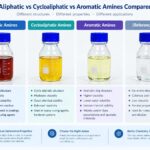
For amine curing agents, a useful first classification is based on the starting amine and the main structure of the finished molecule. Four families are commonly discussed: aliphatic amines, cycloaliphatic amines, aromatic amines, and polyetheramines.
“Modified” means that a base molecule has been chemically changed to improve handling or performance. Modification may lower free-amine content, improve compatibility with epoxy resin, extend working time, or adjust flexibility. The exact effect depends on the chemistry and formulation.
| Family | Structural feature | Typical strength | Common trade-off |
|---|---|---|---|
| Aliphatic amines | Mainly open carbon chains | Fast room-temperature cure | Shorter working time; stronger handling concerns for some grades |
| Cycloaliphatic amines | Saturated carbon rings | Color and weathering performance | Often higher cost; cure behavior varies by grade |
| Aromatic amines | One or more aromatic rings | Heat resistance and high-temperature performance | Many need heat to cure and may have significant hazard concerns |
| Polyetheramines | Flexible ether-linked chain with terminal amine groups | Low viscosity and flexibility | Often slower cure and may need formulation support |
These families describe structural features, not guaranteed product performance. The epoxy resin, mix ratio, temperature, film thickness, and other ingredients all affect the result. Always check the technical data for the specific system.
Aliphatic amines
Aliphatic amines have amine groups attached to non-aromatic carbon chains. Their high reactivity makes many of them useful for room-temperature curing. They can support fast production cycles and are common in coatings, adhesives, and general-purpose epoxy systems.
That speed has trade-offs. Some unmodified aliphatic amines have short pot life, strong odor, or higher skin and respiratory irritation risks. They may also be more prone to surface defects under cool, damp conditions. Modified grades are used to improve compatibility, reduce free amine, or slow the reaction.
Cycloaliphatic amines
Cycloaliphatic amines contain saturated carbon rings. These rings are different from aromatic rings: they do not have the same conjugated structure. This often supports better color stability and weathering performance than many aliphatic or aromatic systems.
They are common choices for clear or decorative coatings where appearance matters. Their cure rate, viscosity, and outdoor durability still depend on the exact molecule and formulation. “Cycloaliphatic” is a helpful starting point, not a substitute for testing.
Aromatic amines
Aromatic amines contain one or more benzene-like rings. Their rigid structure can support high glass-transition temperatures and heat resistance after cure.
Many basic aromatic amines are solids and need elevated temperatures for processing or cure. Some also have important health hazards. Modified forms may improve handling or compatibility, but do not assume that modification removes all hazards or preserves every property. Review the current safety data sheet and technical data sheet before use.
Polyetheramines
Polyetheramines have a flexible chain with repeating ether links and amine groups at the ends. They are a distinct family: the backbone is built from ether chemistry rather than being a simple aliphatic, cycloaliphatic, or aromatic amine structure.
The flexible chain can lower viscosity and improve toughness or elongation in a cured system. Many grades also provide longer working time. Their slower reaction can be a benefit in large castings or composite processing, but may require heat or a compatible accelerator when faster cure is needed.
Why Phenalkamine Overlaps with Other Families
Phenalkamine is the clearest example of why one classification axis is not enough.
What is phenalkamine?
Phenalkamine is a type of Mannich base. It is produced by reacting a phenol, an aldehyde—commonly formaldehyde—and an amine. The phenol may be phenol, nonylphenol, or cardanol. Cardanol is derived from cashew nut shell liquid.
The amine used in the synthesis is often an aliphatic polyamine. Some formulations may use other amine building blocks, including cycloaliphatic types. So if you trace the raw materials, phenalkamine can overlap with the aliphatic or cycloaliphatic amine families.
That overlap is not a contradiction. “Aliphatic” or “cycloaliphatic” identifies the amine source or structural lineage. “Phenalkamine” identifies a product made through a particular synthesis route and recognized for a distinct performance profile.
Why does the industry list it separately?
The Mannich reaction adds phenolic structure to the curing agent. The phenolic hydroxyl can promote epoxy ring-opening, which helps some phenalkamine systems cure at low temperatures. Certain grades are designed to cure around 0°C, and some supplier systems may be formulated for temperatures below that. Actual minimum cure temperature depends on the grade, resin, ratio, and test conditions.
Phenalkamines can also wet and bond to damp substrates more effectively than many conventional amines. This makes them useful for maintenance work where surface preparation or drying conditions are difficult. Product-specific claims for underwater application should always be confirmed with the supplier.
Cardanol-based phenalkamines bring a renewable raw-material component and a hydrophobic long-chain structure. These features can support adhesion and corrosion protection in demanding environments, including marine and heavy-duty protective coatings. “Bio-based” does not automatically mean harmless or fully sustainable; the full formulation, feedstock source, and safety data still matter.
In everyday purchasing, phenalkamine is often shown beside aliphatic and cycloaliphatic amines because it serves a distinct job: low-temperature cure, damp-substrate adhesion, and corrosion protection. This is a practical, application-led grouping—not a claim that its chemistry has no overlap with the amine families.
Polyamide Is Another Synthesis-Derived Family
Polyamide curing agents provide a second example of classification by synthesis and final structure. They are commonly made by reacting polyamines with dimerized fatty acids. The reaction builds a larger molecule with recurring amide linkages.
That structure can provide flexibility, impact resistance, good adhesion, and longer working time. Polyamides are used in coatings and adhesives where toughness and bonding matter. Compared with faster, smaller amines, they may have higher viscosity and slower cure. The balance varies by grade.
Like phenalkamine, polyamide may use an amine as a starting material. But its final molecular structure and performance are distinct enough that formulators commonly treat it as its own family.
Waterborne Describes the Form, Not the Backbone
“Waterborne” is not a chemical family in the same sense as aliphatic or aromatic amines. It describes a curing agent or coating system designed to be carried or dispersed in water.
A waterborne curing agent still has a chemical backbone. It may be based on a modified aliphatic, cycloaliphatic, or another amine chemistry. Waterborne systems can help reduce reliance on organic solvents, but they still need to meet the required cure, adhesion, water-resistance, and application targets.
When comparing products, ask two separate questions:
- What is the curing agent’s chemical family and modification route?
- Is the product supplied in a waterborne, solventborne, or solvent-free form?
That distinction prevents delivery format from being mistaken for chemical identity.
A Practical Way to Read a Curing Agent Catalog
Use this sequence when reviewing a catalog or discussing a formulation:
- Identify the backbone or amine lineage. Is it aliphatic, cycloaliphatic, aromatic, or polyether-based?
- Check for a synthesis-derived specialty. Does the product use Mannich chemistry, polyamide formation, or another reaction that creates a distinct structure?
- Separate chemistry from delivery form. Waterborne, solventborne, and solvent-free describe formulation or supply form.
- Match the required performance. Consider cure temperature, pot life, substrate moisture, flexibility, color, chemical exposure, and service temperature.
- Verify the exact grade. Compare TDS and SDS data, then run a small compatibility and performance test under conditions close to the actual process.
| Application need | Family to investigate first | What to verify |
|---|---|---|
| Fast room-temperature cure | Aliphatic amine | Pot life, blush risk, handling controls |
| Decorative or clear coating | Cycloaliphatic amine | Color retention, gloss, UV exposure |
| High-temperature service | Aromatic amine | Cure schedule, Tg, safety requirements |
| Flexible casting or composite | Polyetheramine | Viscosity, cure rate, mechanical targets |
| Cold or damp-substrate protection | Phenalkamine | Minimum cure temperature, surface condition, corrosion testing |
| Flexible adhesive or coating | Polyamide | Viscosity, bond strength, cure time |
| Reduced-solvent formulation | Waterborne version of a suitable chemistry | Water compatibility, drying, humidity sensitivity |
These are starting points, not automatic recommendations. A curing agent that performs well in one resin or film thickness may behave differently in another.
Common Questions
Is phenalkamine a modified aliphatic amine?
It can be described that way when discussing its raw-material lineage, because many phenalkamines are made with aliphatic amines. In a performance-focused catalog, it is often treated as a functional specialty because Mannich synthesis adds phenolic chemistry and creates a distinctive use profile. State which classification basis you mean.
Are all phenalkamines made with cardanol?
No. Phenol, nonylphenol, and cardanol can be used in Mannich-base chemistry. Cardanol-based products use a feedstock derived from cashew nut shell liquid. Check product documentation to confirm the actual raw materials and bio-based content.
Does phenalkamine always cure at 0°C or below?
No. Low-temperature performance is grade-specific. The resin, mix ratio, substrate temperature, film thickness, and test method also matter. Confirm the minimum application temperature in the supplier’s technical data.
Is waterborne an alternative to aliphatic or cycloaliphatic chemistry?
Not directly. Waterborne describes the delivery or formulation form. The curing agent still has an underlying chemical structure, so identify both the chemistry and the form when comparing products.
Why do modified amines have different properties from their starting materials?
Modification changes the molecule’s reactive groups, size, compatibility, or flexibility. Some reactions mainly alter an existing structure; others create a substantially different structure. That is why the synthesis route and final molecule both matter.
The Classification in One Minute
Start with the chemistry: aliphatic, cycloaliphatic, aromatic, or polyether-based. Then recognize synthesis-derived specialties such as phenalkamine and polyamide, which may share starting materials with other families but have distinct final structures or performance roles. Finally, describe the delivery form separately: waterborne, solventborne, or solvent-free.
Phenalkamine is not an error in the catalog when it appears beside aliphatic amines. It is a useful functional category with overlapping raw-material origins. The key is to know which question the classification is answering.
For selection, compare the exact resin-hardener system, review its technical and safety data, and test it under real process conditions. Classification narrows the field; formulation testing makes the decision.
Professional Coating & Chemical Solutions
Need help selecting the right raw materials for your formulation? From iron oxide pigments and epoxy resins to redispersible polymer powders, we provide high-performance products with expert technical support.
Solicitar una cotización