Aliphatic vs Cycloaliphatic vs Aromatic Amines Compared
 Джо•
Джо•
How the four main amine curing agent families trade off on color, viscosity, pot life, cure speed, flexibility, and heat resistance — and which trade-offs formulation can move.
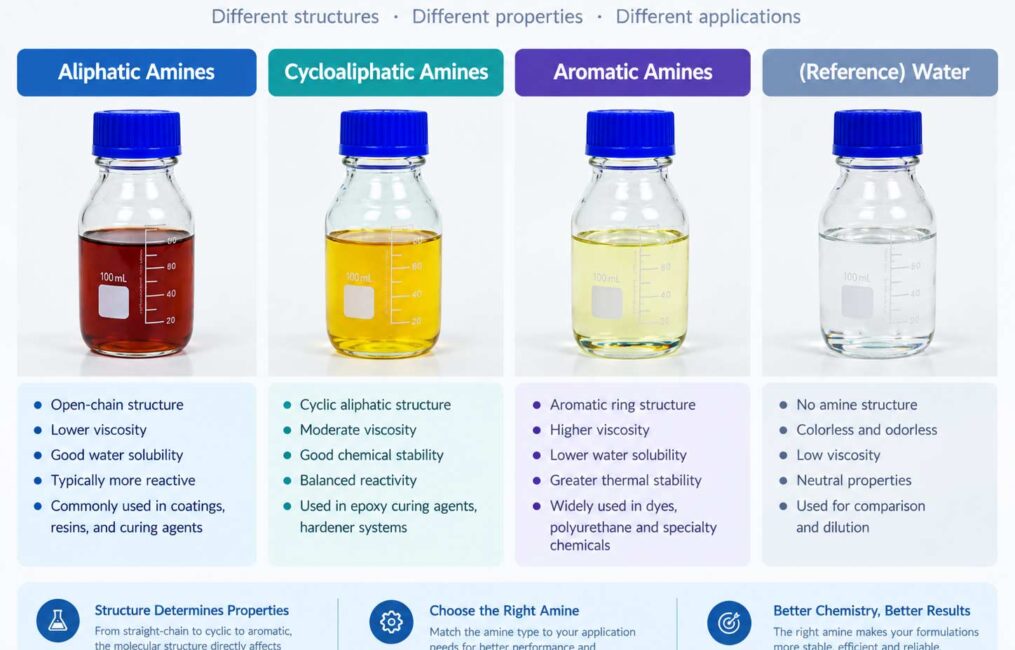
A hardener datasheet tells you what one product does. Very few of them tell you what you gave up to get it.
This article compares the four main amine curing agent families — aliphatic, cycloaliphatic, aromatic, and polyamide — on the same eleven characteristics. It covers where each family is strong, where it is weak, and which of those weaknesses formulation can correct.
The Eleven Comparison Points
Two different things are being compared here, and it helps to keep them apart. Five of the characteristics describe the curing agent as you handle it. Six describe the resin after it has cured.
Handling characteristics of the curing agent:
| Characteristic | Best → worst |
|---|---|
| Color (lightest) | Cycloaliphatic → Aliphatic → Polyamide → Aromatic |
| Viscosity (lowest) | Cycloaliphatic → Aliphatic → Aromatic → Polyamide |
| Pot life (longest) | Aromatic → Polyamide → Cycloaliphatic → Aliphatic |
| Cure speed (fastest) | Aliphatic → Cycloaliphatic → Polyamide → Aromatic |
| Skin irritation (mildest) | Polyamide → Cycloaliphatic → Aromatic → Aliphatic |
Properties of the cured resin, measured on a bisphenol-A epoxy system:
| Cured property | Best → worst |
|---|---|
| Глянец | Aromatic → Cycloaliphatic → Polyamide → Aliphatic |
| Flexibility | Polyamide → Aliphatic → Cycloaliphatic → Aromatic |
| Heat resistance | Aromatic → Cycloaliphatic → Aliphatic → Polyamide |
| Адгезия | Polyamide → Cycloaliphatic → Aliphatic → Aromatic |
| Acid resistance | Aromatic → Cycloaliphatic → Aliphatic → Polyamide |
| Water resistance | Polyamide → Cycloaliphatic → Aliphatic → Aromatic |
Every row runs from the best-performing family to the weakest.
Two qualifications apply to both tables.
These rank backbone classes, not the products you buy. Almost every hardener sold into coatings is a modified grade rather than a base amine, and modification moves a family within these rows — often by several places. An amine adduct, for example, improves the irritation profile and extends pot life well beyond what the unmodified parent shows. What modification does not do is reverse a row. A modified aliphatic amine can beat an unmodified aliphatic amine on handling, but it will not out-perform polyamide on skin irritation, because the straight-chain spine sets the floor. For the numbers on a specific grade, the technical data sheet is the reference.
The four families ranked here are aliphatic, cycloaliphatic, aromatic, and polyamide. Polyetheramine is a separate structural class — an ether backbone rather than a hydrocarbon one — and is generally grouped with the specialty flexible curatives. Many catalogs, including ours, list it alongside the ambient-cure families because that is the role it plays in a formulation, but it is not one of the four compared above.
Reading the Ranking by Family
Cycloaliphatic: no weak rows
Cycloaliphatic amines take first place in color and viscosity — the lightest and the thinnest of the four — and second place in seven of the remaining nine rows. They finish third only in pot life and flexibility, and last nowhere.
That consistency is what the price reflects. Cycloaliphatic amines are the most expensive of the three straight amine families, and the table shows why: there is no single characteristic on which they perform poorly. When a formulation has no dominant requirement — decent color, workable open time, good durability — this is the family that carries the fewest penalties.
The trade is that nothing is best-in-class except color and viscosity. What you buy is the absence of a weakness rather than the presence of a strength.
Aromatic: four firsts, five lasts
Aromatic amines are the most polarized family in the comparison. They lead in pot life, gloss, heat resistance, and acid resistance, and they trail in color, cure speed, flexibility, adhesion, and water resistance.
That is a specialist profile. Aromatic amines are the right choice when service temperature or chemical exposure is the constraint that cannot move, and the wrong choice when appearance, toughness, or room-temperature throughput is the constraint, because they lose those rows outright rather than narrowly.
The practical caution: aromatic amines cure slowly and usually need heat, and they are sometimes selected for the heat-resistance figure alone. A formulator specifies an aromatic amine for a high service temperature and then finds that the cure schedule does not fit the production line. If the process cannot supply heat or a long open time, this family is unavailable regardless of its other numbers.
Aliphatic: fastest cure, shortest working time
Aliphatic amines lead in cure speed and trail in pot life, skin irritation, and gloss. Every other row is mid-pack.
The profile is coherent rather than contradictory. The same high reactivity that produces the fast cure consumes the pot life, raises the handling hazard, and cures too quickly and unevenly to flow out to a smooth film.
The three last places are therefore one property seen from three angles rather than three separate problems. Work that requires the cure speed pays for it on the other three.
This is also the family where modification does the most work, and where the gap between a base amine and a supplied grade is widest. Unmodified DETA or TETA is not what the market sells into coatings, and judging aliphatic amines by those base chemicals understates the family.
Polyamide: toughness and adhesion, with a ceiling on heat and chemicals
Polyamide leads in flexibility, adhesion, water resistance, and mildest skin irritation. It trails in viscosity, heat resistance, and acid resistance.
Those three last places follow from the structure rather than from formulation. The long dimer-acid chain that provides the flexibility, and the hydrogen bonding that drives the adhesion, are the same features that make the molecule viscous and leave the cured network susceptible to heat and aggressive chemicals. The toughness cannot be kept while the limits are discarded.
The mild handling profile is worth noting because it matches a well-established commercial fact: polyamide curing agents are the low-hazard choice among amine hardeners, and that reputation traces to molecular size. A large molecule evaporates less and penetrates skin less than a small one.
Which Trade-Offs Formulation Can Move
The point of ranking families is not to memorize the order. It is to know which rows you can buy your way out of and which ones are fixed.
| Row | Can you move it? | How |
|---|---|---|
| Skin irritation | Yes, substantially | Adducts, ketimines, higher-molecular-weight modification |
| Pot life | Yes, substantially | Adducts, blocking, latent curing agents, dilution |
| Cure speed | Partly | Accelerators and heat, but you cannot beat aliphatic’s ceiling |
| Вязкость | Partly | Reactive diluents, solvent, formulation temperature |
| Цвет | Partly | Cycloaliphatic base or careful modification; aliphatic and aromatic bases stay amber to dark |
| Flexibility | No, not past the backbone | Flexibilizers and diluents add toughness, but the backbone sets the floor |
| Heat resistance | No, not past the backbone | Aromatic ring rigidity is what it is |
| Acid resistance | No, not past the backbone | Determined by the cured network’s chemistry |
The pattern: the top five rows are handling properties, and handling properties respond to formulation. The bottom three are cured-network properties, and a cured network only knows what its backbone built.
That is the practical reason the aliphatic-versus-cycloaliphatic-versus-aromatic decision is worth making carefully at the start. It is not the last decision in a formulation — it is the one that closes doors.
Matching the Family to the Requirement
Read the ranking backwards — start from the requirement you cannot compromise, and take the family that does not lose that row.
| Your hard constraint | Family to start with | What you accept |
|---|---|---|
| Fastest possible room-temperature cure | Aliphatic | Short pot life, harsher handling, duller finish |
| Light color, clear or decorative film | Cycloaliphatic | Higher cost, no best-in-class strength |
| Highest service temperature | Aromatic | Heat or long cure, dark color, brittle film |
| Toughest, best-bonding film | Polyamide | Slow cure, high viscosity, limited heat and acid resistance |
| Longest open time, lowest exotherm | Aromatic or Polyamide | Slow cure |
| Best chemical and solvent resistance | Aromatic | Everything in the aromatic column |
| Lowest handling hazard | Polyamide | Everything in the polyamide column |
| No single dominant requirement | Cycloaliphatic | Higher cost |
Two pairs in that table are easy to confuse and worth separating.
Cycloaliphatic and aromatic amines both appear in outdoor and high-durability applications, but they get there by opposite mechanisms and they are not interchangeable. Cycloaliphatic amines stay clear because their saturated rings have no UV chromophore to absorb light. Aromatic amines resist heat and chemicals because their conjugated rings are rigid and stable. Choosing between them is a question of which durability you mean.
Polyamide and polyetheramine are both chosen for toughness, but again by different routes. Polyamide flexibility comes from a long fatty-acid chain and hydrogen bonding, and it arrives with strong adhesion and high viscosity. Polyetheramine flexibility comes from ether linkages rotating in the backbone, and it arrives with low viscosity and longer pot life. Adhesives lean polyamide. Castings and composites lean polyetheramine.
Two Tiers in the Supply Chain
The families above describe chemistry. The market you buy from has a second structure layered on top of it, and the two do not line up.
Tier one is basic amines. IPDA, PACM, DETA, TETA, DDM, and commodity polyetheramines come from large petrochemical producers. They are sold on specification, and the specification is the same regardless of whose name is on the drum.
Tier two is modified curing agents. Here a manufacturer reacts a base amine with something else — epoxy resin, dimer acid, cardanol, acrylonitrile — to build a molecule with properties the base amine does not have.
| Basic amines | Modified curing agents | |
|---|---|---|
| Source | Petrochemical commodity | Formulated and reacted |
| Who supplies | Tier-1 chemical producers | Hardener specialists |
| Differentiation | Price and logistics | Performance and formulation |
| Custom grades | No | Yes |
| Technical support | Datasheet only | Formulation assistance |
| Typical examples | IPDA, PACM, DETA, DDM | Phenalkamine, polyamide, amine adducts |
This matters because the commercial tier cuts across the chemical family. IPDA and PACM are cycloaliphatic amines and DETA is aliphatic, but all three sit in the same commercial tier. Meanwhile a cardanol-based phenalkamine and a polyamide — two different chemistry stories — sit together in tier two.
So when a supplier offers you IPDA at an attractive price, you are buying a commodity and the price is the whole conversation. When a supplier offers you a grade tuned for cold-weather cure on damp steel, you are buying engineering, and the questions to ask are different ones.
Часто задаваемые вопросы
Is cycloaliphatic better than aliphatic?
Not universally — it is broader, not stronger. Cycloaliphatic amines finish last on none of the eleven rows, while aliphatic amines finish last on three. But aliphatic amines win cure speed outright, and they are cheaper. If your process is throughput-limited and your appearance requirements are modest, aliphatic is the better choice despite the weaker overall profile.
Why do aromatic amines cure so slowly?
The conjugated ring structure that gives them their heat and chemical resistance is also stable and unreactive at room temperature. Many basic aromatic amines are solids as well, which limits how easily they mix and diffuse into the resin. The result is a cure that generally needs elevated temperature or a long schedule.
Can I blend two amine families?
Yes, and it is standard practice when one family alone cannot meet both the process and the performance requirements. Common pairings include aliphatic with polyamide, and polyamide with aromatic. A blend averages the rows, so it is a reasonable way to trade a little of one property for a little of another. It does not let you escape a backbone limit: blending an aromatic into an aliphatic raises heat resistance somewhat without reaching what a pure aromatic system delivers.
Does the ranking change if I use a different epoxy resin?
Yes. The cured-property ranking was established against bisphenol-A epoxy resin, which is the most common base resin, but the resin contributes to the network too. A novolac resin will shift the heat-resistance picture, and a flexibilized resin will shift the flexibility picture. Treat the ranking as the curing agent’s contribution, not as the final answer for your system.
Where does phenalkamine fit in these tables?
It is not one of the four ranked families, for the same reason polyetheramine is not: the comparison ranks backbone classes, and phenalkamine is defined by a synthesis route rather than a backbone class. It is built from aliphatic amines but the Mannich reaction replaces the backbone, which is what gives it low-temperature cure and damp-substrate adhesion. Judge it on its own technical data, not by its position in a family table.
The Short Version
Four amine families measured on eleven rows produce four distinct profiles. Cycloaliphatic finishes last nowhere, which is why it costs more and why it is the safe default. Aromatic wins four rows and loses five, which makes it a specialist for heat and chemical resistance. Aliphatic wins cure speed and pays for it with pot life, handling, and gloss. Polyamide wins toughness, adhesion, water resistance, and handling safety, and pays with viscosity, heat resistance, and acid resistance.
Modification shifts a family along these rows but does not reverse them. Handling properties respond to formulation; cured-network properties do not. Decide the family by the row you cannot compromise, then let modification and formulation handle the rest.
If you are weighing two families for a specific system, send us the cure conditions and the performance target. We will tell you which rows are actually at risk in your case, and send the technical data for the grades that fit.
Professional Coating & Chemical Solutions
Need help selecting the right raw materials for your formulation? From iron oxide pigments and epoxy resins to redispersible polymer powders, we provide high-performance products with expert technical support.
Запросить расценки