Industrial Grade PVA Supply: Crosslinking & Modification
 Joe•
Joe•
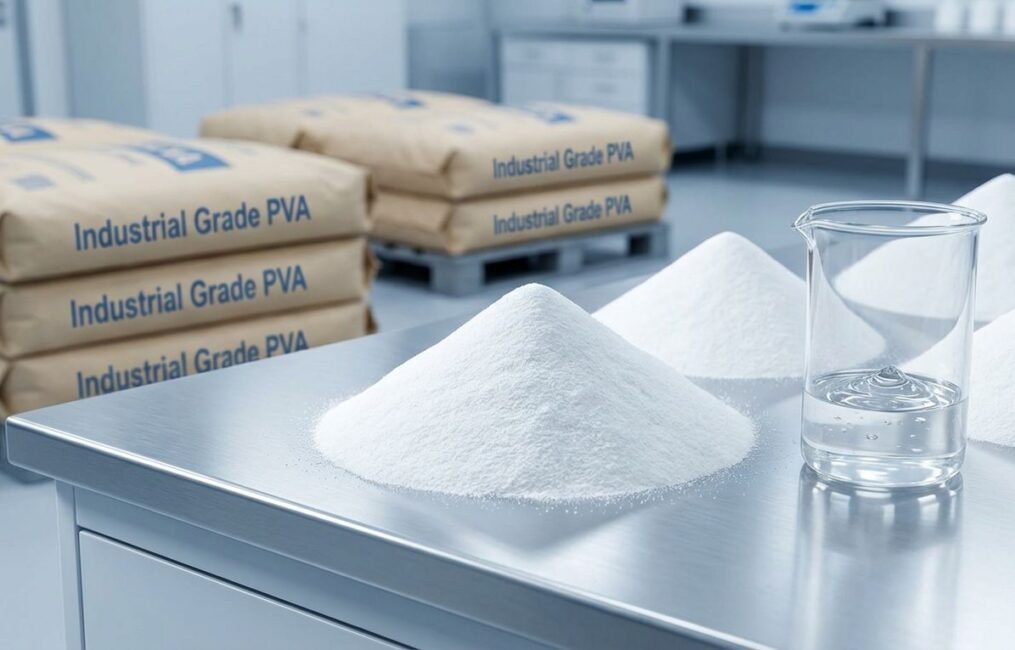
The Necessity of PVA Modification Polyvinyl Alcohol (PVA) is a cornerstone polymer in the global chemical market, valued for its exceptional film-forming properties, high tensile strength, and resistance to organic solvents. At rawchemicalmart.com, we supply a vast array of PVA grades—ranging from partially hydrolyzed (e.g., 17-88, 24-88) to fully hydrolyzed types (e.g., 17-99, 26-99). However,
The Necessity of PVA Modification
Polyvinyl Alcohol (PVA) is a cornerstone polymer in the global chemical market, valued for its exceptional film-forming properties, high tensile strength, and resistance to organic solvents. At rawchemicalmart.com, we supply a vast array of PVA grades—ranging from partially hydrolyzed (e.g., 17-88, 24-88) to fully hydrolyzed types (e.g., 17-99, 26-99). However, the very characteristic that makes PVA desirable—its water solubility—is also its primary limitation in structural and exterior applications.
For industries requiring durability in humid environments, such as construction adhesives or exterior coatings, standard unmodified PVA is susceptible to dissolution and swelling. Overcoming water solubility and thermal limitations requires strategic modification. By altering the polymer structure, engineers can transform hydrophilic PVA into a robust, water-resistant material suitable for rigorous industrial demands.
Procurement Tip: When sourcing base PVA for modification, the degree of hydrolysis is a critical specification. Fully hydrolyzed grades (98-99%) already offer better water resistance than partially hydrolyzed grades (87-89%), but often require higher temperatures to dissolve initially.
Chemical Crosslinking of PVA
The most effective method to enhance the stability of Polyvinyl Alcohol is through chemical crosslinking. This process involves introducing a crosslinking agent that reacts with the hydroxyl (-OH) groups on the PVA backbone, creating a three-dimensional network structure. This network restricts the mobility of the polymer chains and reduces the availability of hydrophilic groups, thereby drastically reducing water sensitivity.
Reaction Mechanisms: PVA Crosslinking with Glutaraldehyde
Among various aldehydes, glutaraldehyde (GA) is a widely used agent for reaction mechanisms in PVA crosslinking. The reaction typically occurs under acidic conditions (catalyzed by HCl or H2SO4). During acetalization, the aldehyde groups of glutaraldehyde react with the hydroxyl groups of adjacent PVA chains to form acetal bridges.
This chemical bridge effectively “locks” the structure. The result is a crosslinked polyvinyl alcohol that exhibits significantly reduced swelling ratios in water. For R&D engineers, controlling the concentration of glutaraldehyde is vital; excessive crosslinking can lead to brittleness, while insufficient crosslinking fails to achieve the desired water resistance.
Alternative Crosslinking Agents
While aldehydes are effective, specific industrial applications require alternative agents due to toxicity concerns or specific performance targets. Common alternatives include:
| Crosslinking Agent | Mechanism | Primary Application |
|---|---|---|
| Boric Acid / Borax | Forms di-diol complexes with PVA hydroxyl groups. | Adhesives, slime/putty toys, and oil field fracturing fluids. |
| Glyoxal | Similar acetalization to glutaraldehyde but generally less toxic. | Paper coatings and textile sizing. |
| Epichlorohydrin | Etherification reaction under alkaline conditions. | Water treatment membranes and ion-exchange resins. |
| Genipin | Natural crosslinker reacting with primary amines (if modified) or hydroxyls. | Biomedical hydrogels (low toxicity). |
Sourcing Industrial Grade PVA?
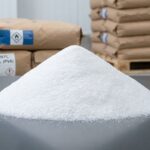
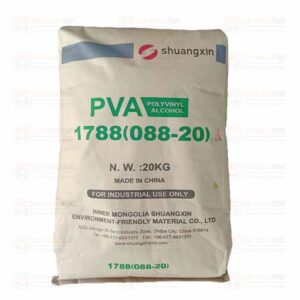
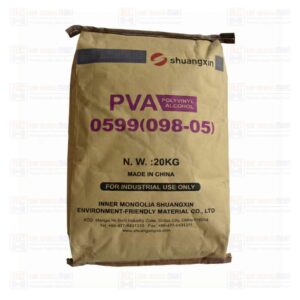
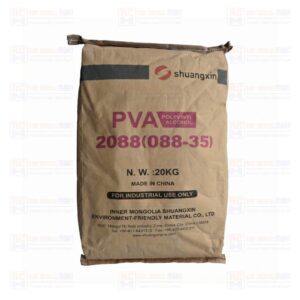
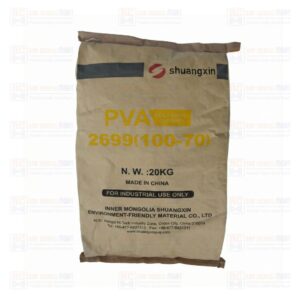
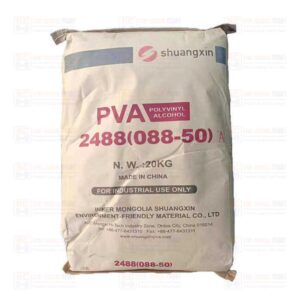
As a leading global supplier, Raw Chemical Mart provides a comprehensive portfolio of Polyvinyl Alcohol (PVA) tailored for high-volume manufacturing, from textiles to advanced adhesives.
PVA Hydrogel Crosslinking: Synthesis and Applications
PVA hydrogel crosslinking represents a high-value application sector, particularly in medical wound dressings and agricultural water-retention systems. Unlike simple surface coatings, hydrogels are three-dimensional networks capable of holding large amounts of water without dissolving.
While chemical crosslinkers create permanent gels, physical crosslinking via freeze-thaw cycling is gaining traction. In this method, a PVA solution is frozen and thawed repeatedly. Ice crystals force the PVA chains into close proximity, inducing the formation of crystallites that act as physical crosslinking points. This method avoids potential toxicity from chemical agents, making the resulting hydrogel ideal for pharmaceutical applications.
Physical Modification and PVA Blend Composites
Not all modifications require chemical reactions. Physical modification and PVA blend composites offer a cost-effective route to enhanced performance. By blending PVA with other polymers such as starch, chitosan, or alginate, manufacturers can tailor the biodegradation rate and mechanical properties.
For example, in the packaging industry, blending PVA with starch decreases the overall cost and increases biodegradability, although it may reduce tensile strength. To counteract this, compatibilizers or nano-fillers (like silica or clay) are often added to the blend matrix to improve interfacial adhesion between the polymers.
Key Performance Improvements
The ultimate goal of modifying PVA is to meet specific technical data sheet (TDS) requirements for end-users. Through crosslinking and blending, three primary performance metrics are enhanced.
Achieving Water Resistant PVA
Achieving water resistant PVA is the primary driver for modification. Unmodified PVA films can dissolve in seconds to minutes upon water contact. A properly crosslinked PVA film, however, may only swell slightly or remain insoluble even in boiling water. This transformation is essential for exterior wood adhesives (D3/D4 classes) and construction additives distributed by rawchemicalmart.com.
PVA Mechanical Strength Improvement
Crosslinking increases the rigidity of the polymer network. This leads to substantial PVA mechanical strength improvement, specifically regarding Young’s Modulus and tensile strength. However, procurement officers should note that as hardness increases, elongation at break typically decreases. Balancing the crosslinking density is key to maintaining enough flexibility to prevent cracking under stress.
Enhancing PVA Thermal Stability
Standard PVA begins to degrade rapidly above 200°C. Enhancing PVA thermal stability via crosslinking allows the material to withstand higher processing temperatures without decomposing. This is particularly relevant for melt-processing applications where PVA is extruded into films or filaments.
Safety & Handling: When handling crosslinking agents like Glutaraldehyde or Borax alongside PVA powder, always consult the Material Safety Data Sheet (MSDS). Ensure proper ventilation and PPE, as crosslinkers are often more reactive and hazardous than the inert PVA base polymer.
Conclusion and Industrial Applications
The transition from standard Polyvinyl Alcohol to crosslinked polyvinyl alcohol unlocks a spectrum of industrial possibilities, moving the material from simple paper adhesives to advanced engineering applications. Whether through chemical bonding with aldehydes or physical modification via blending, these strategies address the inherent limitations of water solubility and thermal instability.
At rawchemicalmart.com, we understand that consistency is the bedrock of your supply chain. We provide high-purity PVA grades suitable for modification, ensuring distinct viscosity and hydrolysis parameters that R&D teams can rely on. From construction binders to advanced hydrogels, our global logistics network ensures your raw materials arrive on time and within specification.