

Breve introduzione:
Polyvinyl Alcohol 26-99 (also known as PVA 2699 or 100-78) is a fully hydrolyzed, ultra-high viscosity grade polymer.
With a viscosity range of 76.0 – 85.0 mPa.s and a hydrolysis degree of 98.00 – 100.00 mol%, this grade offers the highest tensile strength and bonding power in the standard PVA series. It is engineered for heavy-duty industrial applications where maximum adhesion, water resistance, and film strength are critical.
Specifiche:
| Articolo | Specificazione |
|---|---|
| Degree of Alcoholysis (mol%) | 98.00 - 100 |
| Viscosity (mPa·s) | 76.0 - 85.0 |
| Volatile Content (wt%, max) | 5 |
| Purity (wt%, min) | 93.5 |
| Valore del pH | 5 ~ 7 |
| Ash Content (wt%, max) | 0.5 |
Main Characteristics:
-
Solubilità: Highly hydrophilic but requires hot water (above 90°C) for complete dissolution due to its high molecular weight and full hydrolysis. It is insoluble in most organic solvents.
-
Film Properties: Forms extremely tough films with excellent mechanical properties and high tensile strength. Provides a superior barrier against gases ($H_2$, $N_2$, $O_2$).
-
Stabilità termica: Stable up to 130°C. Being fully hydrolyzed, it begins to melt around 230°C and decompose above 200°C.
-
Resistance: Offers robust resistance to weak acids, weak alkalis, and oils.
-
Reactivity: Excellent cross-linking capability with boric acid or formaldehyde (acetalization) to create water-resistant adhesives.
Applicazioni:
PVA 26-99 is the preferred binder for high-strength applications:
-
Construction Industry: widely used in the production of construction glues (e.g., 107 glue), interior/exterior wall coatings, and acetalized adhesives.
-
Ceramic Industry: Acts as a high-strength temporary binder for ceramic bonding and aluminum balls, providing excellent green strength before firing.
-
Paper Tube Manufacturing: Used in the adhesive industry for paper tubes and cores where high initial tack and final bond strength are required.
-
Emulsion Stabilizer: Used as a thickener and stabilizer for Vinyl Acetate (PVAc) and Urea-Formaldehyde (UF) emulsions.
Imballaggio:
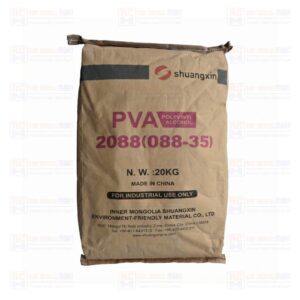
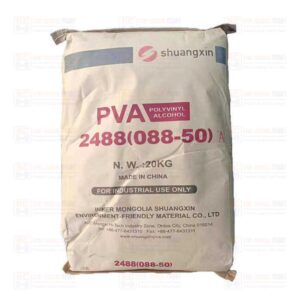
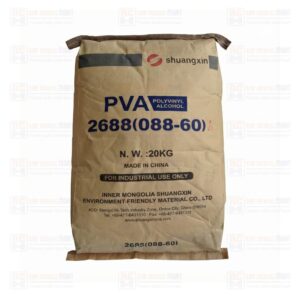
- Confezione: 25 kg per bag (Kraft paper bag with plastic liner).
Prodotto Magazzinaggio:
- Magazzinaggio: Store in a cool, dry, and well-ventilated area to prevent caking and moisture absorption.
FAQ:
Q: What is the difference between PVA 26-99 and PVA 26-88?
A: Both are ultra-high viscosity grades (~60-80 mPa.s), but they differ in hydrolysis:
-
PVA 26-99 (Fully Hydrolyzed): Better water resistance, higher tensile strength, and higher melting point (~230°C). Ideal for construction glues and ceramics.
-
PVA 26-88 (Partially Hydrolyzed): Better solubility, flexibility, and surface activity. Ideal for PVC suspension polymerization.
Q: Why is PVA 26-99 used in ceramics?
A: In ceramic manufacturing, PVA 26-99 acts as a binder. Its high viscosity provides exceptional “green strength” (strength of the unfired ceramic body), preventing breakage during handling before the firing process. It burns off cleanly during firing.
Q: How difficult is it to dissolve PVA 26-99?
A: Due to its very high viscosity and full hydrolysis, it is the most difficult grade to dissolve. You must use hot water (90°C-95°C) and agitate vigorously for a longer period compared to lower viscosity grades like 17-99 to ensure a homogeneous solution.
Need High-Strength PVA 26-99? Reach out to us. We supply ultra-high viscosity Polyvinyl Alcohol 2699 for heavy-duty industrial bonding.