How to Make Yellow Iron Oxide: A Synthesis Guide
 Joe•
Joe•
Discover the industrial synthesis of Yellow Iron Oxide (Pigment Yellow 42). This guide covers precipitation, quality control, and key chemical reactions.
How to Make Yellow Iron Oxide: Synthesis and Manufacturing Guide
Yellow Iron Oxide, known chemically as hydrated iron(III) oxide (α-FeOOH) and by its Colour Index name Pigment Yellow 42, is one of the most vital inorganic pigments in modern industry. Its excellent lightfastness, chemical resistance, and non-toxic nature make it indispensable in construction, coatings, plastics, and more. But how is this vibrant, stable pigment produced on an industrial scale? The answer lies in a precise chemical synthesis and manufacturing process.
This technical guide details exactly how to make yellow iron oxide, exploring the core manufacturing methods, the underlying chemical reactions, and the critical quality control steps that ensure high-performance pigments like those supplied by Rawchemicalmart.com.
Understanding Synthetic Yellow Iron Oxide (FeOOH)
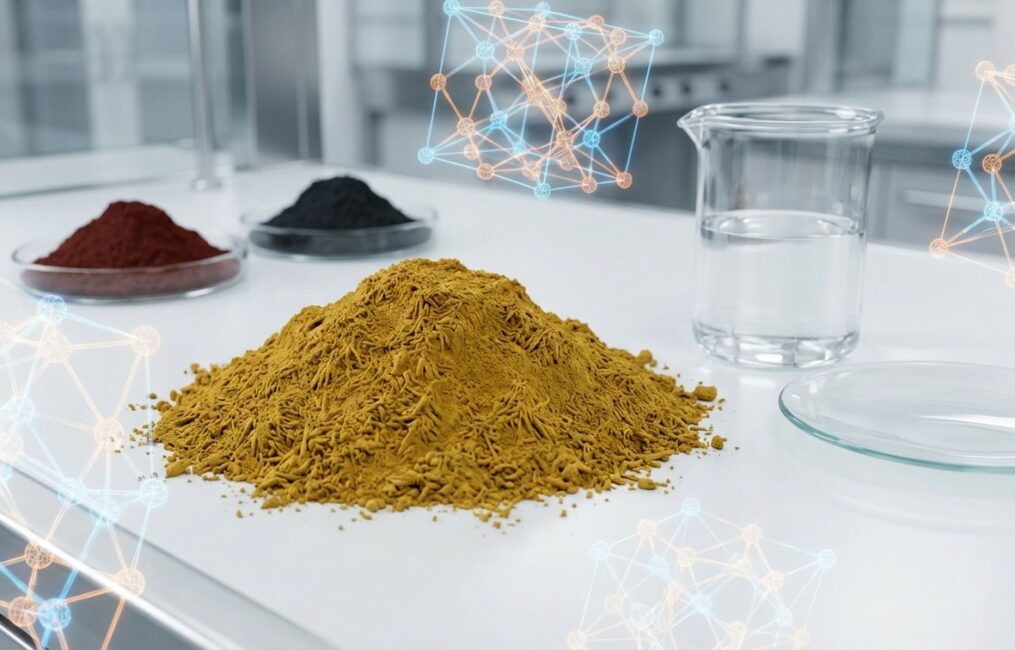
Unlike naturally occurring ochres, synthetic yellow iron oxide is manufactured under controlled conditions to achieve high purity, consistent particle size, and superior color strength. The target chemical compound is goethite (α-FeOOH), a hydrated form of iron oxide. Its distinct acicular, or needle-like, crystal structure is responsible for its bright yellow hue and high opacity.
This morphology distinguishes it from its counterparts:
- Red Iron Oxide (Fe₂O₃ – Hematite): Typically has a rhombohedral or spherical particle shape.
- Black Iron Oxide (Fe₃O₄ – Magnetite): Has a cubic crystal structure.
The success of synthetic yellow iron oxide production hinges on the ability to precisely control the formation and growth of these acicular goethite crystals.
The Manufacturing Process: Key Methods
While several methods exist, two processes dominate the industrial production of yellow iron oxide: the Precipitation method and the Penniman-Zoph process. Both are designed to create a controlled environment for goethite crystal growth.
The Precipitation Method (Precipitated Yellow Iron Oxide)
The most common modern technique is the precipitation method. This process involves reacting an iron salt solution, typically ferrous sulfate (FeSO₄), with an alkali to precipitate iron hydroxides. This is followed by controlled oxidation to form the final goethite pigment.
The raw material, ferrous sulfate, is often a co-product from the steel industry’s pickling process, making this a highly efficient and sustainable manufacturing route. The term precipitated yellow iron oxide directly refers to pigments made via this versatile and widely used method.
The Penniman-Zoph Process
A classic and highly effective method, the Penniman-Zoph process builds the pigment directly on seed crystals in a reactor. The process starts with a “seed” slurry of fine goethite nuclei. Scrap iron is introduced into the reactor along with a ferrous sulfate solution. Air is then bubbled through the mixture, causing the scrap iron to slowly oxidize and precipitate onto the seed crystals, gradually growing them to the desired size. This method is renowned for producing pigments with excellent color consistency.
Iron Oxide Yellow Synthesis: The Chemical Reaction
The core of the yellow iron oxide manufacturing process is the controlled oxidation of ferrous ions (Fe²⁺) to ferric ions (Fe³⁺) in an aqueous solution, leading to the formation of goethite (α-FeOOH). The simplified overall reaction using ferrous sulfate is:
4FeSO₄ + 4NaOH + O₂ → 4FeOOH + 2Na₂SO₄
However, achieving the target color and performance requires meticulous control over several reaction parameters.
Controlling pH and Temperature for Color Quality
The pH and temperature of the reaction vessel are the most critical variables in the iron oxide yellow synthesis.
- pH Control: The reaction is typically maintained within a slightly acidic pH range of 3.5 to 5.0. If the pH is too low, the reaction slows dramatically. If it’s too high, undesirable iron hydroxide phases can form, resulting in a dull, muddy color instead of a bright yellow.
- Temperature Control: The temperature is usually kept between 70°C and 90°C. Temperature influences the rate of crystal growth and the final particle morphology. Inconsistent temperatures can lead to a broad particle size distribution, negatively impacting tinting strength and dispersibility.
From Production to Application
Understanding the manufacturing process is just the first step. To see how different production methods affect the final particle size, oil absorption, and industrial grades, check out our complete guide.
View Yellow Iron Oxide Properties & Uses Guide →Seed Formation and Oxidation
The process is a two-stage crystal growth mechanism. First, a small amount of alkali is added to the iron salt solution to create a suspension of goethite “seed” nuclei. Once these seeds are formed, the main oxidation step begins. Air is bubbled through the reactor, and the ferrous salt solution is added slowly. This allows the newly formed goethite to precipitate onto the existing seed crystals, ensuring uniform growth and a narrow particle size distribution, which is key for achieving a high-quality pigment like Yellow 313.
Step-by-Step Production Workflow
Following the chemical synthesis in the reactor, the pigment slurry undergoes several mechanical processing steps to become a finished, saleable product.
Filtration and Washing
The pigment slurry from the reactor contains soluble salts (e.g., sodium sulfate) as byproducts. These must be removed. The slurry is pumped into filter presses, where the solid pigment is separated from the liquid. The resulting pigment “cake” is then washed extensively with water to reduce the soluble salt content to a minimum. This step is crucial for applications in coatings, as high salt content can lead to blistering, poor adhesion, and corrosion.
Drying and Micronization
The washed filter cake is dried, often using large-scale spray dryers, to remove residual moisture and create a fine powder. However, this powder consists of agglomerates (clumps of primary particles). To ensure easy dispersion in customer applications, the dried pigment undergoes micronization—a milling or grinding process that breaks down these agglomerates and achieves the final specified particle size distribution. This step is vital for performance in paint dispersion and developing full color strength in plastic masterbatches.
Calcination Process for Iron Oxide
While yellow iron oxide is a final product, it also serves as a precursor for producing high-quality red iron oxides through a process called calcination.
Thermal Treatment and Phase Transformation (Yellow to Red)
Le calcination process for iron oxide involves heating the yellow goethite pigment (FeOOH) in a calciner or rotary kiln to temperatures above 180°C (356°F). This thermal treatment drives off the chemically bound water molecule, causing an irreversible phase transformation:
2FeOOH (Yellow) + Heat → Fe₂O₃ (Red) + H₂O
By carefully controlling the calcination temperature and duration, manufacturers can produce a wide range of red shades, from a light orange-red (like Red 110) to a deep, bluish-red (like Red 130 or Red 190). This highlights the thermal instability of yellow iron oxide, a critical consideration for formulators in high-temperature applications like engineering plastics or coil coatings.
Quality Control in Industrial Production
Rigorous quality control is essential to guarantee that each batch of yellow iron oxide meets stringent industrial specifications. Key parameters are tested throughout the manufacturing process.
All high-quality synthetic iron oxide pigments must conform to international standards such as ISO 1248:2014 (Pigments for colouring building materials based on cement and/or lime) and comply with chemical regulations like REACH (Registration, Evaluation, Authorisation and Restriction of Chemicals).
The following table outlines typical technical specifications for a standard grade of Iron Oxide Yellow:
| Paramètre | Typical Value (for Yellow 313) | Significance |
|---|---|---|
| Formule chimique | α-FeOOH | Defines the pigment as goethite. |
| C.I. Pigment Yellow 42 | 77492 | Universal color identification number. |
| Force de teinture (%) | 95 – 105 (Relative to Standard) | Measures the pigment’s ability to color a medium. |
| Absorption d'huile (g/100 g) | 25 – 35 | Indicates binder demand in paint and coatings formulations. |
| pH of Aqueous Suspension | 4.0 – 7.0 | Ensures stability and compatibility in water-based systems. |
| Heat Resistance (°C / °F) | 180°C / 356°F | The temperature at which it begins to convert to red iron oxide. |
| Lightfastness (Scale 1-8) | 8 (Excellent) | Guarantees long-term color stability in exterior applications. |
From the precise control of pH in a reactor to final micronization, the production of high-performance yellow iron oxide is a testament to applied chemistry and process engineering. Understanding this process empowers formulators and procurement managers to select the ideal pigment grade that delivers consistent color, durability, and value for their specific application. For reliable, high-purity iron oxide pigments manufactured to these exacting standards, contact the experts at Rawchemicalmart.com.