Oxyde de fer rouge : naturel ou synthétique (Guide B2B)
 Joe•
Joe•
L'oxyde de fer rouge peut être naturel ou synthétique. Découvrez lequel offre la pureté, la constance et les performances requises pour les revêtements industriels, le béton et les plastiques.
L’oxyde de fer rouge est-il naturel ? Une réponse directe pour les formulateurs
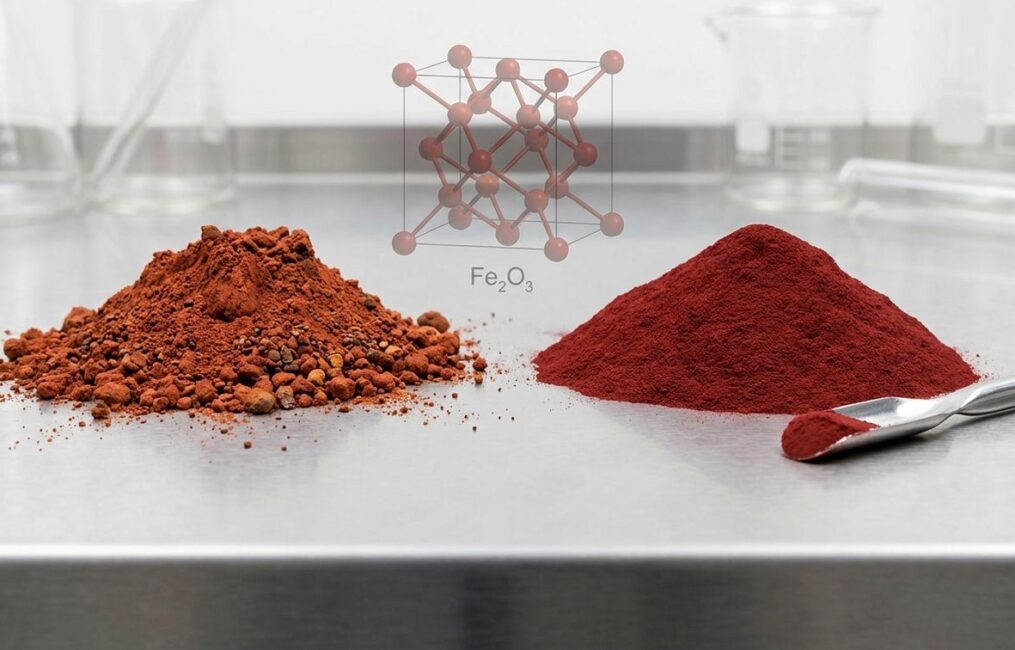
La question, “L'oxyde de fer rouge est-il naturel ?”La réponse à cette question est nuancée et essentielle pour les applications industrielles : l’oxyde de fer rouge peut être les deux. Il existe sous forme de… ocre rouge naturelle pigment extrait de la terre et d'une grande pureté oxyde de fer rouge fabriqué Créés par synthèse chimique précise, ces deux produits sont à base du même composé chimique, l'oxyde de fer(III) (Fe₂O₃). Cependant, leur origine, leur pureté et leurs performances diffèrent considérablement. Pour les ingénieurs en approvisionnement et les formulateurs des secteurs des revêtements, de la construction et des plastiques, la compréhension de ces différences est essentielle pour garantir la qualité, la constance et la conformité des produits.
Cet article propose une comparaison définitive entre les oxydes de fer naturels et synthétiques, en clarifiant leur production, leurs propriétés et leurs applications idéales afin de guider votre processus de sélection des matériaux.
Comprendre l'oxyde de fer rouge naturel
Les oxydes de fer naturels comptent parmi les plus anciens pigments utilisés par l'humanité, appréciés pour leur durabilité et leurs tons terreux. Leur origine est purement géologique, façonnée par des millénaires de processus naturels.
Le rôle du pigment d'hématite et de l'ocre rouge naturelle
La principale source minérale de l'oxyde de fer rouge naturel est pigment d'hématite L'hématite (α-Fe₂O₃) est l'un des minéraux les plus abondants à la surface de la Terre. Les dépôts d'hématite, mélangés à des quantités variables d'argile, de silice et d'autres minéraux, sont appelés ocre. ocre rouge naturelle C’est cette matière première qui est extraite pour produire des pigments naturels. La composition minérale spécifique du gisement détermine la teinte finale, qui peut aller d’un rouge terreux et terne à une nuance plus vive et éclatante. Cependant, cette origine naturelle est aussi à l’origine de son principal inconvénient industriel : une irrégularité inhérente.
Extraction et traitement des pigments naturels terrestres
La production d'oxyde de fer rouge naturel est un procédé mécanique, et non chimique. Elle comprend généralement :
- Extraction: Extraction du minerai d'ocre ou d'hématite brut dans les mines à ciel ouvert.
- Concassage et broyage : Réduire les gros morceaux de minerai à une taille gérable.
- Lavage et séparation : Élimination des impuretés plus grosses comme le sable et les roches par lévigation (un processus de lavage et de décantation).
- Séchage et broyage : La suspension de pigment purifiée est séchée puis finement broyée pour obtenir une granulométrie spécifique adaptée à une utilisation comme pigment.
Ce procédé affine la matière première sans en modifier la composition chimique fondamentale. Par conséquent, des impuretés subsistent, influençant la couleur, le pouvoir colorant et les propriétés chimiques.
Définition de l'oxyde de fer rouge synthétique
Contrairement aux oxydes de fer naturels, les oxydes de fer synthétiques sont les produits phares de l'industrie moderne des pigments. Leur fabrication, réalisée dans des conditions rigoureusement contrôlées en laboratoire et en usine, permet d'atteindre une pureté et une homogénéité inégalées.
Définition et classification de l'oxyde de fer rouge synthétique
A définition de l'oxyde de fer rouge synthétique Il s'agit d'un pigment d'oxyde de fer(III) (Fe₂O₃) produit par synthèse chimique et non par extraction minière. Il est classé dans l'indice de couleur CI sous la référence Rouge 101. Ces pigments sont élaborés selon des spécifications précises, et les fabricants proposent différentes qualités, telles que le Rouge 110 (teinte plus jaune), le Rouge 130 (teinte moyenne) et le Rouge 190 (teinte plus bleutée), chacune présentant une granulométrie et une forme spécifiques qui déterminent sa couleur et ses performances.
Méthodes de production synthétique de Fe₂O₃
Les propriétés supérieures des oxydes de fer synthétiques proviennent de leurs procédés de fabrication, qui consistent à construire le pigment particule par particule. Les deux principales méthodes de fabrication sont les suivantes : production synthétique de Fe₂O₃ sont:
- Procédé de précipitation (par exemple, procédé Penniman/Laux) : Il s'agit de la méthode la plus courante. Elle consiste à utiliser une solution de sel de fer (souvent du sulfate ferreux, un sous-produit de la sidérurgie). On y ajoute des déchets de fer et on insuffle de l'air dans le mélange pour précipiter des germes d'oxyde de fer. En contrôlant précisément la température, le pH et la vitesse d'oxydation, ces germes cristallins se développent en particules de taille et de forme spécifiques. Le pigment obtenu (souvent à partir d'oxyde de fer jaune, FeOOH) est ensuite lavé, séché et calciné (chauffé à haute température) pour le convertir en sa forme stable rouge α-Fe₂O₃. Cette méthode offre un contrôle exceptionnel sur le produit final.
- Décomposition thermique : Cette méthode repose sur la décomposition thermique directe de composés du fer. Par exemple, le chauffage direct du sulfate ferreux permet d'obtenir de l'oxyde de fer rouge. Bien qu'efficace, la méthode de précipitation offre généralement un contrôle plus précis des caractéristiques du pigment.
Différences critiques : oxyde de fer naturel vs. oxyde de fer synthétique
Pour un formulateur industriel, le choix entre oxyde de fer naturel vs synthétique Sa performance repose sur trois facteurs critiques : la pureté, la constance et la sécurité.
Analyse de l'origine et de la pureté des pigments
La différence la plus significative réside dans origine et pureté des pigments. Les oxydes de fer rouges synthétiques présentent généralement une teneur en Fe₂O₃ supérieure à 96%, avec des impuretés minimales. Les pigments naturels, en revanche, ont une teneur en Fe₂O₃ beaucoup plus faible, souvent comprise entre 60% et 85%, le reste étant composé de silice, d'alumine (argiles) et d'autres oxydes métalliques. Ces impuretés peuvent affecter la réactivité chimique, la dispersion et la résistance aux intempéries du produit final.
Cohérence de la couleur et pouvoir colorant
Grâce à la maîtrise de la taille et de la distribution des particules lors de la production de pigments synthétiques, l'homogénéité de la couleur d'un lot à l'autre est exceptionnelle. Ce critère est essentiel pour des applications telles que les revêtements architecturaux ou le béton coloré, où l'uniformité est primordiale. De plus, la finesse et l'homogénéité des particules de pigments synthétiques offrent un pouvoir colorant nettement supérieur, souvent 5 à 10 fois plus élevé que celui des pigments naturels. Il en résulte une quantité moindre de pigment nécessaire pour obtenir l'intensité de couleur souhaitée, ce qui permet d'optimiser la formulation.
Teneur en métaux lourds et sécurité
Les oxydes de fer synthétiques sont fabriqués à partir de matières premières purifiées, ce qui garantit des teneurs en métaux lourds extrêmement faibles et prévisibles. Ils peuvent ainsi être utilisés en toute sécurité dans de nombreuses applications, y compris celles impliquant un contact humain. Les pigments naturels peuvent contenir des niveaux variables, voire élevés, de métaux lourds à l'état de traces, selon la géologie du site minier.
Pour les applications de construction, des normes comme ASTM C979 (Pigments pour béton coloré dans la masse) Il convient de fixer des limites aux substances hydrosolubles afin d'éviter que les pigments n'affectent le temps de prise et la résistance du béton. Les oxydes de fer synthétiques de haute pureté répondent à ces normes, tandis que les pigments naturels peuvent nécessiter des tests rigoureux pour chaque lot.
Applications : Quand utiliser l'oxyde de fer rouge manufacturé
Si les pigments naturels conviennent aux applications artistiques ou lorsqu'une nuance “ terreuse ” est recherchée, les secteurs industriels de haute performance utilisent presque exclusivement des pigments naturels. oxyde de fer rouge fabriqué pour sa fiabilité et ses propriétés supérieures.
- Revêtements et peintures : Le pouvoir colorant élevé, la teinte pure, la résistance aux UV et l'inertie chimique des rouges synthétiques les rendent idéaux pour les revêtements automobiles, industriels et architecturaux qui nécessitent une durabilité à long terme et une fidélité des couleurs.
- Construction: Pour la coloration du béton, des pavés, des briques et des tuiles, la constance de la couleur des pigments synthétiques d'un lot à l'autre est essentielle pour éviter les effets de damier et garantir l'homogénéité du projet. Leur pureté garantit également l'absence d'impact négatif sur la résistance à la compression du béton.
- Plastiques et mélanges-maîtres : Les oxydes de fer synthétiques offrent une excellente stabilité thermique (dépassant souvent 800 °C) et une bonne dispersibilité, qui sont essentielles pour résister aux hautes températures de transformation des polymères sans changement de couleur ni dégradation.
Tableau récapitulatif : Comparaison des spécifications des produits naturels et synthétiques
Le tableau ci-dessous présente une comparaison claire et rapide des spécifications techniques typiques des pigments d'oxyde de fer rouge naturels et synthétiques.
| Propriété | Oxyde de fer rouge naturel (ocre/hématite) | Oxyde de fer rouge synthétique (par exemple, Rouge 130) |
|---|---|---|
| Formule chimique | Fe₂O₃ + impuretés (SiO₂, Al₂O₃, etc.) | Fe₂O₃ |
| Teneur en Fe₂O₃ (%) | 60 – 85% | > 96% |
| Force de teinture (%) | Faible à modérée (variable) | Élevé (95 – 105% vs. Standard) |
| Absorption d'huile (g/100 g) | Variable, souvent plus élevée (25-45) | Contrôlé, généralement plus bas (22-28) |
| valeur du pH | Variable (5-9) | Contrôlé (4-8) |
| Résistance à la chaleur | Variable, la couleur peut changer en raison d'impuretés. | > 800 °C |
| Résistance à la lumière (échelle de laine bleue) | 8 (Excellent) | 8 (Excellent) |
| Cohérence des couleurs | Faible (variation d'un lot à l'autre) | Très élevé (ΔE < 1,0) |
| Pureté / Impuretés | Contient des niveaux importants de silice et d'argiles | oligo-éléments contrôlés à des concentrations de ppm |
En conclusion, si l'oxyde de fer rouge est bien naturel sous sa forme minérale, sa version synthétique offre la pureté, la constance et les performances requises pour les produits industriels modernes de haute spécification. Pour des résultats fiables et reproductibles, le choix est évident : l'oxyde de fer synthétique est le matériau de choix pour les formulateurs.
Technical Support for Industrial Chemicals
Need technical documents, pricing, or shipping information? Tell us the product grade, application, required quantity, and destination port for a prompt quotation.
Demander un devis