L’oxyde de fer jaune est-il sans danger ? Guide de la FDA et de la toxicité
 Joe•
Joe•
Guide complet sur la sécurité de l'oxyde de fer jaune. Nous analysons sa toxicité, sa conformité aux réglementations de la FDA et sa pureté pour les applications industrielles, cosmétiques et alimentaires.
L’oxyde de fer jaune est-il sans danger ? Analyse complète de sa sécurité et de sa toxicité
Pour les formulateurs industriels, les ingénieurs d'approvisionnement et les développeurs de produits, la sécurité n'est pas seulement une priorité, c'est une nécessité. Lors du choix d'un colorant comme l'oxyde de fer jaune, il est primordial de s'interroger sur son profil de sécurité. La question principale, “ l'oxyde de fer jaune est-il sûr ? ”, exige une réponse nuancée qui prenne en compte sa nature chimique, son procédé de fabrication, sa qualité d'application et le cadre réglementaire. Ce guide de référence propose une analyse scientifique de la toxicité de l'oxyde de fer jaune, de son approbation par la FDA et de la sécurité globale de ce pigment.
Qu’est-ce que l’oxyde de fer jaune ? (Composition chimique et pureté)
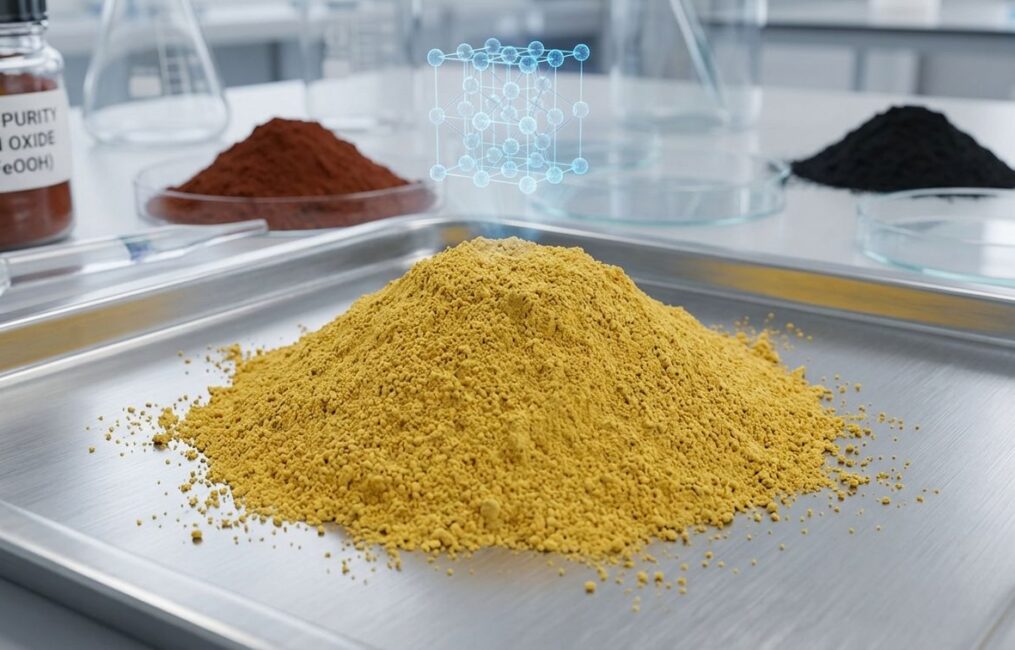
L'oxyde de fer jaune, également appelé oxyde de fer(III) hydraté ou oxyde-hydroxyde de fer(III), est un pigment inorganique de formule chimique α-FeOOH. Dans l'industrie des colorants, il est universellement identifié par son nom dans l'indice de couleur (CI) : Pigment jaune 42 (CI 77492).
Chez RawChemicalMart, nous fournissons de l'oxyde de fer jaune synthétique de haute pureté. Contrairement aux ocres naturelles, qui peuvent contenir des impuretés en quantités variables, les ocres synthétiques sont produites dans des conditions rigoureusement contrôlées (par exemple, par le procédé Penniman ou de précipitation). Ceci garantit une pureté exceptionnelle, une constance d'un lot à l'autre et un profil chimique sûr et prévisible, exempt de contaminants de métaux lourds parfois présents dans les minéraux extraits des mines.
Les propriétés physiques et chimiques d'une qualité haute performance typique, telle que le Jaune 313, sont essentielles à ses performances et à sa sécurité.
Propriétés physiques typiques : Oxyde de fer jaune (grade 313)
| Propriété | Valeur typique | Méthode d'essai |
|---|---|---|
| Formule chimique | α-FeOOH | – |
| Nom/Numéro CI | Pigment jaune 42 / 77492 | – |
| Force de teinture | 95 – 105 % | ISO 787-16 |
| Absorption d'huile | 25 à 35 g/100 g | ISO 787-5 |
| valeur du pH | 4.0 – 7.0 | ISO 787-9 |
| Résistance à la chaleur | 180 °C (356 °F) | – |
| Résistance à la lumière (échelle de 1 à 8) | 8 (Excellent) | ISO 105-B02 |
| Résistance aux intempéries (échelle de 1 à 5) | 5 (Excellent) | ISO 2810 |
Profil général de sécurité et de toxicité
Il existe un consensus général au sein des communautés scientifiques et réglementaires : les oxydes de fer synthétiques sont exceptionnellement sûrs. Leur inertie et leur insolubilité sont essentielles à leur profil non toxique.
L’oxyde de fer est-il toxique pour l’homme ? (Résolution des idées reçues)
Une source fréquente de confusion concerne le rôle du fer dans l'organisme et l'innocuité des pigments d'oxyde de fer. Si le fer est un nutriment essentiel, celui contenu dans des pigments comme l'oxyde de fer jaune (α-FeOOH), l'oxyde de fer rouge (Fe₂O₃) et l'oxyde de fer noir (Fe₃O₄) se trouve à l'état stable, oxydé et insoluble. De ce fait, il est biochimiquement indisponible pour l'organisme. Ingéré en petites quantités, il traverse le système digestif en grande partie sans être absorbé. toxicité de l'oxyde de fer jaune est considérée comme extrêmement faible voire négligeable en cas d'exposition aiguë.
Oxydes de fer synthétiques ou naturels : lesquels sont les plus sûrs ?
Cette distinction est cruciale pour toute application de haute précision. Les oxydes de fer synthétiques sont manifestement plus sûrs que leurs homologues naturels (ocres, terres de Sienne, ombres terrestres) pour une raison principale : pureté. Le procédé de fabrication des pigments synthétiques est conçu pour produire une substance chimique pure, éliminant ainsi le risque de contaminants indésirables et souvent toxiques tels que les métaux lourds comme le plomb, le mercure, l'arsenic et le cadmium, qui peuvent être présents dans les pigments naturels extraits de la terre.
Normes réglementaires et approbation de la FDA
L'excellent profil de sécurité des oxydes de fer se reflète dans leur large approbation par les organismes de réglementation du monde entier. Ce solide cadre réglementaire est une pierre angulaire de sécurité des pigments d'oxyde de fer.
Réglementation de la FDA relative aux colorants (21 CFR)
Aux États-Unis, la Food and Drug Administration (FDA) réglemente les colorants alimentaires. Les oxydes de fer synthétiques de haute pureté figurent sur la liste des colorants autorisés pour une utilisation dans les aliments, les médicaments et les cosmétiques.
Sous 21 CFR 73, Les oxydes de fer synthétiques sont répertoriés comme colorants “ exemptés de certification ”. Cela signifie qu'ils sont reconnus comme sûrs en raison de leur longue utilisation et de leurs propriétés chimiques connues, à condition qu'ils répondent aux spécifications rigoureuses d'identité et de pureté définies par la FDA.
Ce oxyde de fer approuvé par la FDA Le statut est essentiel pour tout produit destiné au contact humain ou à la consommation, confirmant son aptitude à des applications sensibles.
Conformité réglementaire mondiale (UE, REACH)
L'acceptation mondiale des oxydes de fer renforce encore leur réputation en matière de sécurité.
- Union européenne (UE)En Europe, l'oxyde de fer jaune est autorisé comme colorant alimentaire sous le code E172. Il est également approuvé pour toutes les applications cosmétiques sans restriction.
- ATTEINDREEn vertu du règlement REACH (enregistrement, évaluation, autorisation et restriction des substances chimiques) en Europe, les oxydes de fer sont enregistrés et ne sont pas classés comme substances dangereuses.
Sécurité par niveau d'application
La sécurité de l'oxyde de fer jaune dépend également du choix de la qualité appropriée à l'application prévue. Bien que toutes les qualités synthétiques soient intrinsèquement sûres, les niveaux de pureté sont adaptés aux exigences réglementaires et de performance spécifiques.
Oxyde de fer jaune de qualité cosmétique (sans danger pour la peau, usage autour des yeux)
Pour l'industrie cosmétique, oxyde de fer jaune de qualité cosmétique Il doit répondre aux normes de pureté les plus strictes, avec des limites exceptionnellement basses pour les métaux lourds. C'est un ingrédient essentiel des fonds de teint, correcteurs, poudres et fards à paupières. Ses propriétés le rendent idéal pour cet usage :
- Non irritant et non sensibilisantIl est considéré comme hypoallergénique et sûr pour une application topique sur tous les types de peau.
- Sécurité de la zone oculaireSon utilisation est approuvée dans les cosmétiques pour le contour des yeux, ce qui témoigne de sa nature douce et non toxique.
Oxyde de fer jaune de qualité alimentaire (limites d'ingestion et code E172)
Comme mentionné, oxyde de fer jaune de qualité alimentaire Le colorant E172 est autorisé pour la consommation. Il est utilisé en infimes quantités pour colorer des produits tels que les boyaux de saucisses, les aliments pour animaux et certains enrobages pharmaceutiques. Son utilisation est réglementée par une dose journalière admissible (DJA), mais sa faible biodisponibilité fait qu'il ne présente aucun risque aux concentrations utilisées dans les produits alimentaires.
De la production à l'application
Comprendre le processus de fabrication n'est que la première étape. Il faut ensuite observer comment les différentes méthodes de production influencent le produit final. Taille des particules, absorption d'huile et qualités industrielles, Consultez notre guide complet.
Consultez le guide sur les propriétés et les utilisations de l'oxyde de fer jaune →Qualité industrielle vs. Qualités de haute pureté
Pour des applications telles que les revêtements de construction et industriels, les qualités industrielles standard sont la norme. Ces qualités offrent d'excellentes performances en termes de résistance aux intempéries dans les peintures extérieures, de résistance aux UV et de stabilité chimique. Elles sont conçues pour donner une couleur intense au béton sans nuire à sa résistance à la compression et pour se disperser facilement dans les mélanges-maîtres plastiques. Bien que très pures comparées aux pigments naturels, elles peuvent ne pas respecter les limites strictes de métaux lourds requises pour les usages cosmétiques ou alimentaires. Il incombe au formulateur de choisir la qualité qui correspond aux exigences de contact et réglementaires de l'application.
Données techniques de sécurité (Résumé de la FDS)
Un examen de Fiche de données de sécurité (FDS) de l'oxyde de fer Ce document fournit des informations pratiques sur la manipulation du produit. La fiche de données de sécurité (FDS) confirme que l'oxyde de fer jaune n'est pas classé comme substance dangereuse. Les principales précautions à prendre concernent l'hygiène industrielle des poudres fines.
Manipulation, risques d'inhalation et exigences en matière d'EPI
L’oxyde de fer jaune est considéré comme une “ poussière gênante ”. Il n’est pas chimiquement toxique par inhalation, mais comme toute poudre fine, une inhalation excessive peut provoquer une irritation physique temporaire des voies respiratoires. Par conséquent, il est recommandé d’appliquer les pratiques d’hygiène industrielle standard.
- VentilationTravaillez dans des zones bien ventilées.
- Équipement de protection individuelle (EPI): Lors de la manipulation de grandes quantités ou dans des situations où de la poussière peut être générée, portez des lunettes de sécurité avec protections latérales, des gants et un masque respiratoire anti-poussière approuvé par le NIOSH (par exemple, N95).
- DéversementsLes liquides renversés doivent être balayés ou aspirés afin d'éviter la formation de poussières en suspension dans l'air.
Conclusion : Verdict sur la sécurité des pigments
L'oxyde de fer jaune est-il donc sans danger ? La réponse est sans équivoque : Oui, à condition d'utiliser la qualité appropriée pour l'application prévue. L'oxyde de fer jaune synthétique (pigment jaune 42) présente un profil de sécurité exceptionnel, caractérisé par :
- inertie chimiqueIl est non toxique, insoluble et biochimiquement indisponible.
- Haute puretéLe procédé de fabrication synthétique élimine les impuretés nocives.
- Approbation réglementaireIl est approuvé par la FDA, l'UE et d'autres organismes internationaux pour une utilisation dans les applications les plus sensibles, notamment dans les secteurs alimentaire et cosmétique.
- Risques de manipulation minimesLe seul risque significatif réside dans la poussière, source de nuisances, facilement gérable avec les EPI standard.
Pour les ingénieurs et les formulateurs, l'oxyde de fer jaune est l'un des colorants les plus sûrs, les plus fiables et les plus polyvalents du marché. Afin de garantir la conformité de votre projet aux normes de sécurité et de performance, collaborez avec un fournisseur capable de fournir des données techniques complètes et des certificats d'analyse pour chaque qualité. Contactez RawChemicalMart dès aujourd'hui pour demander un échantillon ou discuter des exigences spécifiques de votre formulation.
Technical Support for Industrial Chemicals
Need technical documents, pricing, or shipping information? Tell us the product grade, application, required quantity, and destination port for a prompt quotation.
Demander un devis