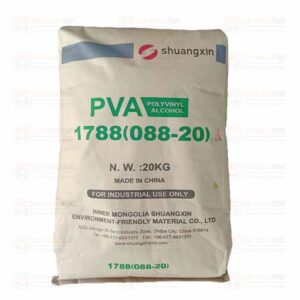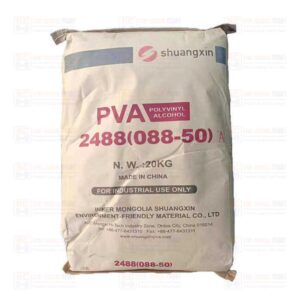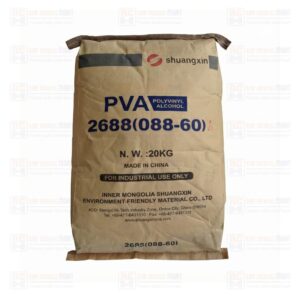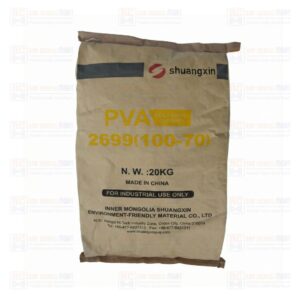


Breve introducción:
Alcohol polivinílico 20-88 (también conocido como PVA 2088 o 088-35) es un parcialmente hidrolizado polímero de grado caracterizado por una única viscosidad media-alta rango.
Con una viscosidad de 28,0 – 43,0 mPa·s, El PVA 20-88 ofrece una mayor adherencia inicial y espesor de película en comparación con los grados estándar 17-88, a la vez que mantiene mejores propiedades de fluidez que los grados de alta viscosidad 24-88. Este equilibrio lo convierte en la opción preferida para aplicaciones industriales que requieren un control reológico preciso, como agentes endurecedores para abrasivos y adhesivos rehumectables.
Presupuesto:
| Artículo | Especificación |
|---|---|
| Grado de alcoholismo (mol%) | 86.00 - 90.00 |
| Viscosidad (mPa·s) | 28.0 - 43.0 |
| Contenido volátil (wt%, máx.) | 5 |
| Pureza (wt%, mín.) | 93.5 |
| Valor de pH | 5 ~ 7 |
| Contenido de cenizas (wt%, máx.) | 0.5 |
Características principales:
-
Solubilidad: Fácilmente soluble en agua. Si bien puede disolverse lentamente a temperatura ambiente, se recomienda disolverlo en agua caliente por encima de 85 °C para la eficiencia.
-
Punta de procesamientoPuede generarse espuma durante la disolución; se recomienda añadir un agente antiespumante.
-
-
Punto de fusión: Como grado parcialmente hidrolizado, comienza a fundirse alrededor de 180-190 °C y se descompone por encima de los 200 °C.
-
ViscosidadPresenta una excelente capacidad de adhesión no solo a materiales hidrofílicos (celulosa, papel), sino también a fibras hidrofóbicas.
-
Propiedades cinematográficasForma películas flexibles y resistentes con excelentes propiedades de barrera contra los gases.
-
Compatibilidad: Compatible con almidón, gomas y otras emulsiones.
Aplicaciones:
-
Abrasivos y moldes recubiertos: Específicamente utilizado para Rigidez del tejido base y el refuerzo en la industria de los abrasivos (por ejemplo, el soporte del papel de lija).
-
Adhesivos: Ideal para formular adhesivos rehumectables (pegamentos humectantes) utilizados en sellos postales, sobres y cintas de papel.
-
Industria textil: Se utiliza en el procesamiento de fibras para fibras cortas y filamentos largos con el fin de mejorar la eficiencia del tejido.
-
Procesamiento de películas: Se utiliza como materia prima para la fabricación de películas solubles en agua.
-
Estabilizador: Funciona como un coloide protector en la polimerización de emulsiones de acetato de vinilo (PVAc).
Embalaje:
- Embalaje: 25 kg por saco.
- AlmacenamientoAlmacenar en un lugar fresco, seco y bien ventilado para evitar que se apelmace y absorba la humedad.
Producto Almacenamiento:
Conservar en un lugar seco y bien ventilado para evitar la absorción de humedad.
Preguntas frecuentes:
P: ¿Cuándo debo elegir PVA 20-88 en lugar de PVA 17-88?
A: Deberías elegir PVA 20-88 cuando necesite una viscosidad ligeramente mayor (28-43 mPa·sy una fuerza de adhesión superior a la que ofrece el 17-88 (19-32 mPa·s). Es ideal para aplicaciones donde el 17-88 resulta demasiado líquido o fluido, como en el endurecimiento de tejidos o en aplicaciones adhesivas verticales.
P: ¿El PVA 20-88 forma espuma durante la disolución?
R: Sí, como muchos grados parcialmente hidrolizados, puede generar espuma durante el proceso de disolución. Recomendamos agregar una pequeña cantidad de agente antiespumante (antiespumante) durante el proceso de calentamiento para garantizar una solución transparente y sin burbujas.
P: ¿Cuál es la temperatura de fusión del PVA 20-88?
A: A diferencia de los grados totalmente hidrolizados que se funden a temperaturas más altas (~230 °C), el PVA 20-88 comienza a fundirse en un rango más bajo de 180-190 °C. Este punto de fusión más bajo puede resultar ventajoso en ciertas aplicaciones de procesamiento de termoplásticos.
¿Necesita PVA de viscosidad media-alta? Solicita un presupuesto. Suministramos alcohol polivinílico 20-88 de primera calidad para aplicaciones industriales especializadas.
Technical Support for Industrial Chemicals
Need technical documents, pricing, or shipping information? Tell us the product grade, application, required quantity, and destination port for a prompt quotation.
Solicitar una cotización