Black Iron Oxide for Ceramics: A Technical Guide
 Joe•
Joe•
Technical guide for B2B formulators on Black Iron Oxide (Fe3O4) pigment. Learn its use in clay bodies, glazes, and firing for consistent ceramic color.
Understanding Black Iron Oxide as a Ceramic Pigment
Black Iron Oxide is one of the most fundamental and versatile colorants used in the formulation of black iron oxide ceramics. Unlike synthetic black stains, which are often complex calcined mixtures of cobalt, chrome, and manganese, iron oxide provides a cost-effective and powerful route to achieving a spectrum of colors from subtle grays to deep, saturated blacks. Its behavior is highly dependent on its chemical nature, particle size, and the kiln environment, making a technical understanding essential for consistent results.
Chemical Composition (Fe3O4) vs. Red Iron Oxide
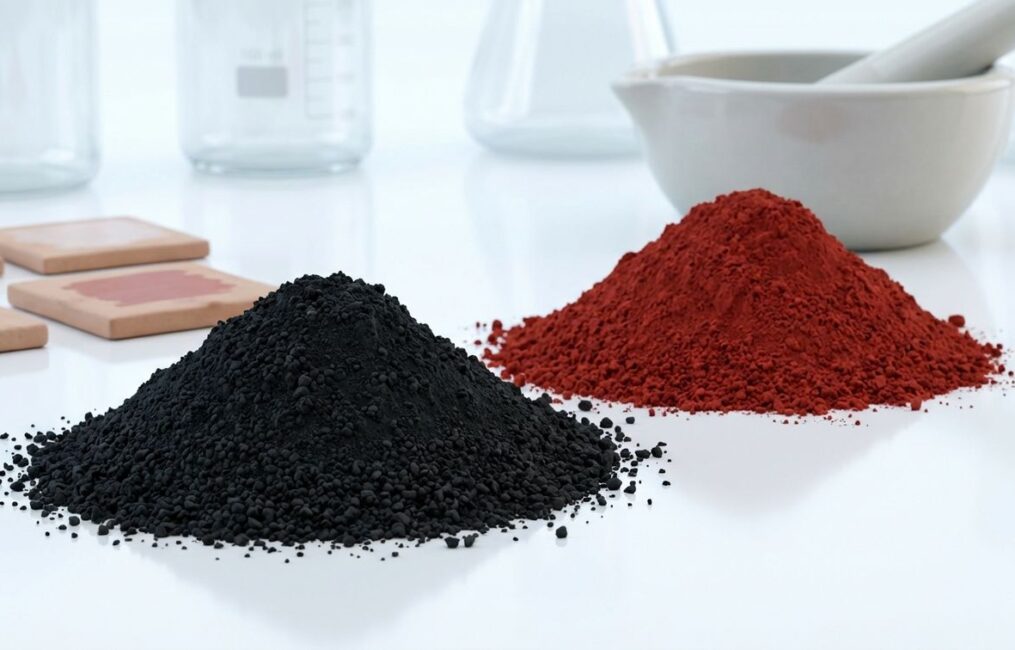
The key difference between black and red iron oxides lies in their oxidation state. Black Iron Oxide is chemically magnetite (Fe3O4), a mixed-valence compound containing both ferrous (Fe²⁺) and ferric (Fe³⁺) iron. Red Iron Oxide is hematite (Fe2O3), containing only ferric (Fe³⁺) iron. This chemical distinction is the primary driver of their different behaviors in ceramic applications.
Fe3O4 acts as a more powerful flux than Fe2O3 because the ferrous iron (FeO) component has a lower melting point. This fluxing action can significantly impact the maturation temperature and melt characteristics of both clay bodies and glazes. In an oxidizing atmosphere, Black Iron Oxide will attempt to convert to the more stable Red Iron Oxide (Fe2O3), a transformation that typically begins around 540°C (1004°F).
| ملكية | Black Iron Oxide (Grade 722) | Red Iron Oxide (Grade 130) |
|---|---|---|
| الصيغة الكيميائية | Fe3O4 | Fe2O3 |
| C.I. Name | Pigment Black 11 | Pigment Red 101 |
| Morphology | Cubic / Octahedral | Spherical / Rhombohedral |
| امتصاص الزيت (جم/100 جم) | 15 – 25 | 20 – 30 |
| قيمة الرقم الهيدروجيني | 5 – 9 | 4 – 8 |
| Thermal Stability (in Air) | Oxidizes to Fe2O3 above 540°C | Stable to >800°C |
| Lightfastness | 8 (Excellent) | 8 (Excellent) |
Sourcing High-Quality Pigment
For industrial ceramic production, pigment consistency is paramount. Sourcing a high-quality ceramic pigment black iron oxide from a reputable supplier like Raw Chemical Mart ensures minimal batch-to-batch variation. Key quality control parameters for formulators to consider include:
- Purity: Low levels of soluble salts and manganese are critical. Soluble salts can cause scumming on clay body surfaces, while manganese impurities can alter the fired color unpredictably.
- Particle Size Distribution (PSD): A consistent PSD ensures predictable melting behavior and color development. Finer particles will melt and react more readily, while coarser particles can create speckling effects.
- Tinting Strength: This measures the pigment’s ability to color a standard white base, providing a reliable metric for its coloring power and ensuring formulation consistency.
High-performance iron oxide pigments should conform to international standards such as ISO 1248:2006, which specifies the requirements and corresponding test methods for iron oxide pigments.
Need Full Iron Oxide Black Technical Data?
Explore our Ultimate Guide for in-depth purity standards, production methods, and professional sourcing strategies for Fe3O4 pigments.
View the Ultimate Pillar Guide →Incorporating Iron Oxide Black in Clay Bodies
Using iron oxide black in clay bodies is a direct method for achieving integral color. The pigment is typically added to the wet clay at the mixing stage, ensuring homogeneous distribution. The final color is a result of the iron percentage, the base clay composition, and the firing atmosphere.
Coloring Stoneware and Porcelain
In porcelain bodies, which are naturally low in iron, additions of 1-5% black iron oxide can produce a range of cool, steely grays. In black iron oxide stoneware, which often contains its own native iron and impurities, the same additions will produce warmer, earthier grays and browns. To achieve a true, deep black, additions can range from 8-12%. The iron interacts with other minerals in the stoneware, like silica and feldspar, to create complex, rich colors that are difficult to replicate with stains alone.
Saturation Limits and Fluxing Issues
A critical consideration is the potent fluxing nature of black iron oxide. As the percentage of Fe3O4 increases, the vitrification point of the clay body decreases. While this can be beneficial for achieving density at lower temperatures, exceeding the saturation limit can cause significant problems. Typically, additions above 12% can lead to:
- Bloating and Blistering: The iron over-fluxes the clay, causing it to become too fluid and trap gases released during firing.
- Brittleness: An over-fluxed body can become glassy and brittle, compromising the structural integrity of the final piece.
- Glaze Fit Issues: A significant change in the clay body’s coefficient of thermal expansion (CTE) can lead to glaze defects like crazing or shivering.
Formulators must conduct systematic testing to determine the optimal pigment loading for their specific clay body and firing cycle.
Black Iron Oxide for Pottery Glaze Formulation
When used as a black iron oxide for pottery glaze, Fe3O4 is a powerful and dynamic colorant. It can be used in small percentages (0.5-2%) to modify other colors or in high percentages (8-15%) to become the primary colorant, producing a range of classic and dramatic effects.
Achieving Metallics and Tenmoku Effects
One of the most sought-after effects with iron is the Tenmoku glaze. This is an iron-saturated glaze, typically containing 8-12% black iron oxide. During a specific cooling cycle, the iron precipitates out of the molten glaze solution and forms crystals on the surface. Depending on the base glaze chemistry and cooling speed, this can result in a deep, lustrous black, a rust-brown “hare’s fur” effect, or an “oil spot” pattern. At even higher concentrations, a dry, metallic, or gunmetal surface can be achieved as the iron completely oversaturates the glaze.
Interaction with Other Colorants
Black iron oxide is rarely used in isolation. Its interaction with other metallic oxides is key to developing a complex glaze palette:
- With Rutile (TiO2 with Fe impurities): Small additions of rutile can encourage the crystallization of iron, breaking the color and creating mottled, variegated surfaces.
- With Cobalt Oxide (Co3O4): Adding a small amount of cobalt (0.5-1%) to an iron-based black glaze can produce a deeper, more intense jet-black that remains stable in both oxidation and reduction.
- With Calcium Carbonate (Whiting): In high-calcium glazes, iron can produce yellowish or greenish hues, especially at lower concentrations.
Firing Schedules and Temperature Effects
The final appearance of black iron oxide ceramics is determined as much by the firing as it is by the formulation. Temperature and atmosphere work together to transform the raw pigment into a permanent ceramic color.
Black Iron Oxide at Cone 6 (Mid-Fire)
At mid-fire temperatures, specifically for black iron oxide cone 6 applications (~1222°C / 2232°F), Fe3O4 is a very active flux. In an oxidizing atmosphere, it reliably produces stable blacks, warm browns, and ambers, depending on the concentration and base glaze. It is a cornerstone colorant for many mid-fire potters and industrial producers due to its reliability and the rich, warm tones it imparts, especially in stoneware glazes.
Oxidation vs. Reduction Atmospheres
The kiln atmosphere has a profound effect on iron oxide.
- Oxidation (Oxygen-Rich): In an electric kiln, the atmosphere is typically oxidizing. Here, Fe3O4 will tend to convert to Fe2O3, shifting colors towards browns, reds, and ambers. A true black in oxidation often requires a high iron concentration or the addition of other fluxes/colorants like cobalt.
- Reduction (Oxygen-Starved): In a fuel-burning kiln (gas, wood), a reduction atmosphere can be created by limiting oxygen. This forces the glaze to seek oxygen from metallic oxides. The Fe2O3 and Fe3O4 are reduced to ferrous oxide (FeO), a very powerful flux that produces the classic deep blacks of Tenmoku and the subtle greens and blues of Celadon glazes (which use very low iron percentages).
Best Practices for Handling and Safety
While iron oxide pigments are generally considered low-toxicity, they are fine powders that pose an inhalation risk. Proper industrial hygiene should always be observed when handling any dry ceramic material.
- Personal Protective Equipment (PPE): Always wear a NIOSH-approved respirator or dust mask, safety glasses, and gloves when handling dry pigments.
- Ventilation: Work in a well-ventilated area or use local exhaust ventilation (LEV) systems to capture airborne dust at the source.
- Housekeeping: Clean work surfaces with a wet mop or HEPA-filtered vacuum. Avoid using compressed air, which can aerosolize fine pigment particles.
Always consult the Safety Data Sheet (SDS) provided by your supplier for specific handling, storage, and disposal information. Compliance with regulations such as REACH (Registration, Evaluation, Authorisation and Restriction of Chemicals) is essential for ensuring workplace safety and environmental protection.